on
AI search performance KPIs every marketer should track
As long as I’ve been in marketing, people have warned against focusing on “vanity metrics,” or those flashy, high numbers that don’t translate to real results or profit. Fast forward a decade, I never expected traffic and search rank to be part of that conversation.

Since the rise of Google, we marketers have lived and thrived on these two key performance indicators (KPIs). If visits were up and your website sat on page one on SERPs, life was good. Then, AI search happened.
My old friends, traffic and rankings, are still useful, but they no longer tell the full story. Visitors who arrive via AI convert at 4.4x the rate of those from standard organic traffic, according to Semrush. That means a brand can lose 40% of its traffic and still win in AI search. Another can hold a #1 ranking and remain invisible across every AI engine.
That gap is exactly why specific AI search performance KPIs are so important. AI search metrics measure AI search visibility, attribution signals, conversions, and revenue impact from AI-driven discovery — metrics that show true impact on your bottom line.
This guide breaks down each KPI, how to measure it, and how to connect your AI search visibility to pipeline and revenue. Not sure where your brand currently stands? HubSpot’s AI Search Grader is a fast way to benchmark your visibility across AI answer engines before diving in.
Table of Contents
- “Vanity Metrics” in AI Search Reporting: What Not to Track
- What AI search performance KPIs should you track?
- How to Measure AI Visibility and Citation Share
- How to Connect AI Search KPIs to Conversions and Revenue
- Frequently Asked Questions About AI Search Performance KPIs
“Vanity Metrics” in AI Search Reporting: What Not to Track
Today, AI Overviews appear on roughly 48% of all Google searches; that’s up from 31% just a year earlier, according to BrightEdge. Plus, when they appear, organic click-through rates drop as much as 61% even for the top-ranked result.
But why am I rattling off these numbers? Because the way we used to track success in search through organic traffic and clicks doesn’t account for new AI.
If you’re reading this, you already know that AI search needs a whole new set of AI search KPIs; however, here there’s no shortage of impressive-sounding numbers that look good in a slide deck but say nothing about business impact. Don’t get caught up in these “vanity metrics.”
Here are some of the most common vanity metrics in AI Search:
- High AI visibility rate without citation share context: Appearing in 40% of prompts looks great — until a competitor appears in 80%.
- AI referral traffic volume without conversion data: 100 AI-referred sessions per month sounds small. But if they convert at 15%, it may be your highest-value traffic source.
- Citation count without accuracy or sentiment: Being cited 200 times with incorrect pricing or outdated features is worse than being cited 50 times accurately.
- Branded search lift without a baseline: A 10% lift sounds like progress — but progress from where? Without a starting point and a time window, it’s just a number.
In the excitement of rising numbers, businesses can lose sight of the metrics that actually reflect their growth and profitability. Context turns a metric into a signal.
- Visibility rate + conversion rate
- Citation share + pipeline contribution
- Branded search lift + deal influence.
Without it, you’re just celebrating numbers in a meeting and hoping no one asks what they mean for revenue. Next, we’ll dig into six AI search performance KPIs you should be tracking.
AI search KPIs typically fall into three layers:
- Direct metrics: Signals you can measure from specific platform data, like AI referral traffic or Google AI Mode impressions.
- Proxy metrics: Indirect signals that suggest AI influence when direct data isn’t available. In the past, my colleagues and I called these “leading indicators.”
- Business-outcome metrics: Revenue and conversion signals that connect AI search visibility to real results.
Not every brand will have access to every direct metric right now, and that’s okay. The goal is to establish a reporting stack that layers all three, so you’re never relying on a single number.
Note: If you’re building your AI measurement practice from scratch, start with HubSpot’s free AI Search Grader. It benchmarks your current AI search visibility across answer engines and shows where you stand relative to competitors, giving you a starting point before you build anything else.
Direct Metrics
1. AI Visibility Rate
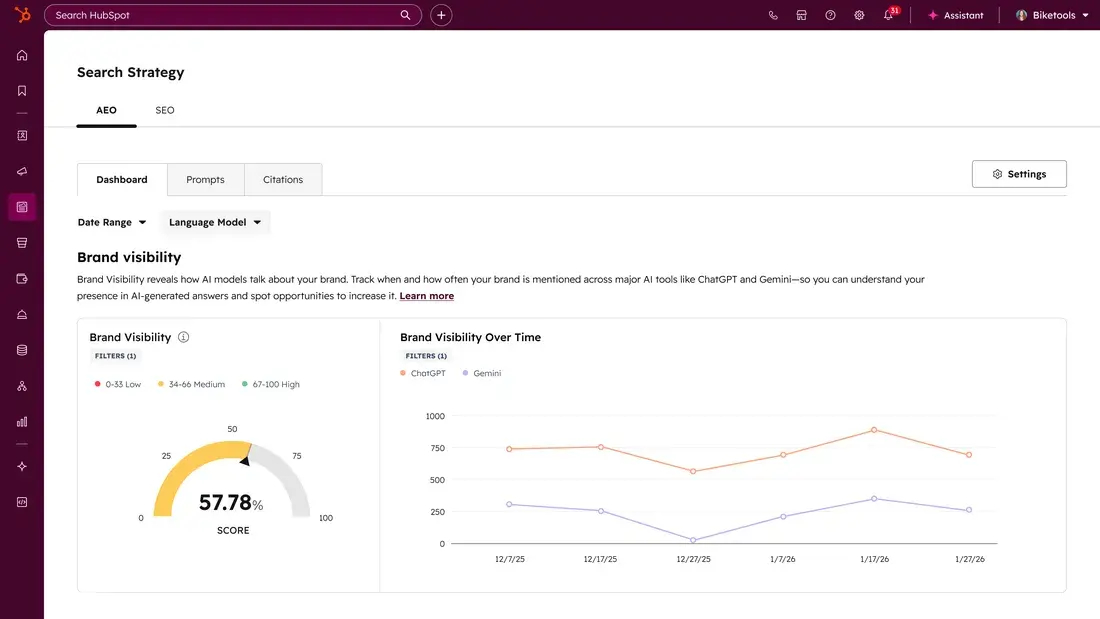
AI visibility rate measures how often your brand appears in AI-generated answers across a defined set of prompts. In other words, it tells you if you’re actually showing up in front of the people that you want to get in front of, and it’s the foundational metric for tracking AI search visibility.
We’ll get granular on how to measure AI Visibility Rate shortly, but here’s what you need to know in a nutshell:
- Formula: (Prompts where your brand appears ÷ Total prompts tested) × 100
- Tools to help: HubSpot AEO, SE Ranking, Semrush, BrightEdge
- Limitation: AI answers vary by user, location, and session. Run checks on a consistent schedule to capture trends, not just snapshots.
2. Citation Share
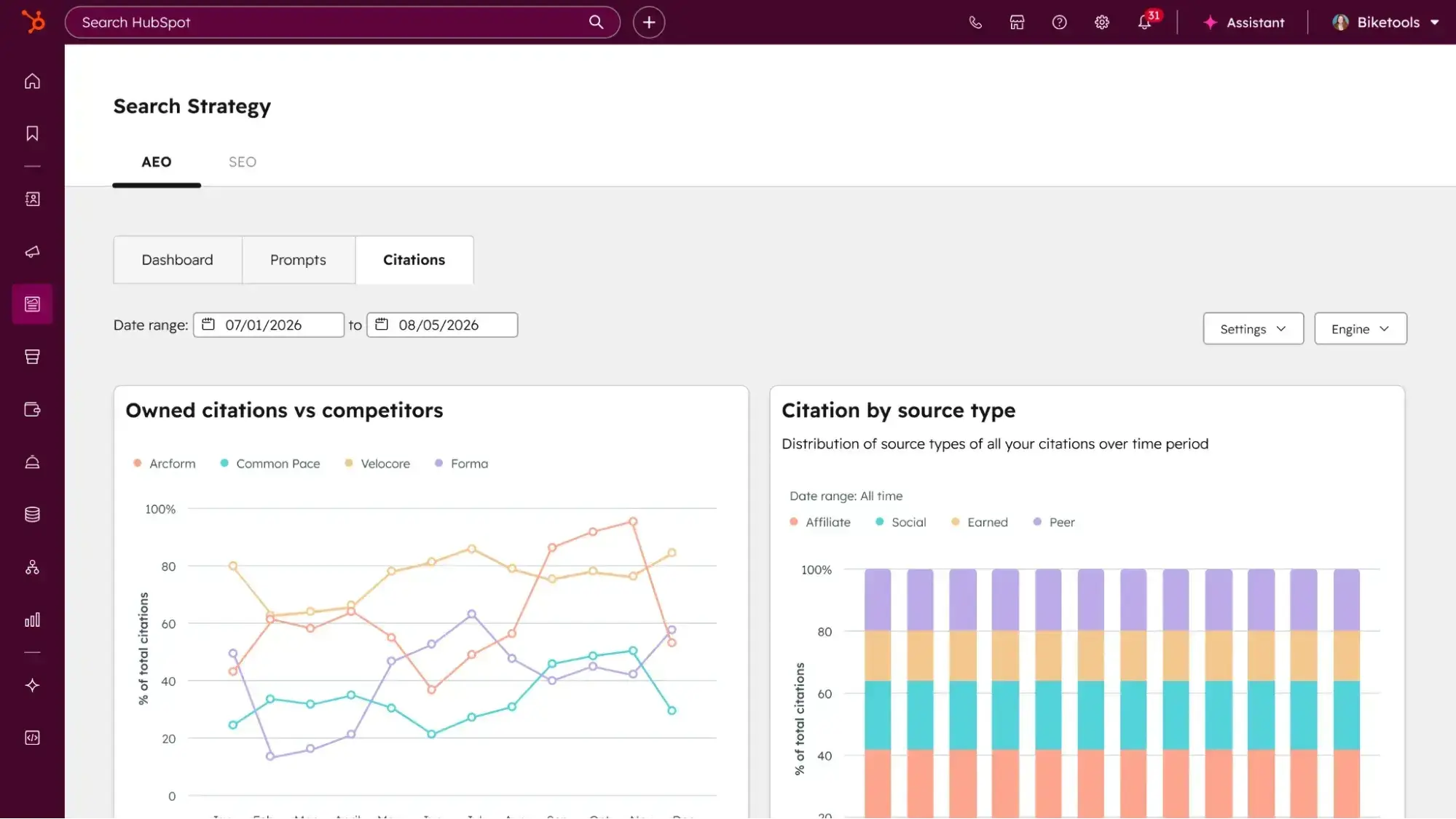
Citation share is your brand’s percentage of citations relative to competitors across the same prompt set. It’s like AI search’s answer to share of voice, putting your visibility number in context.
For instance, you could appear in 30% of AI answers, but if a competitor appears in 60%, you’re losing the AI share of voice battle.
How to Calculate Citation Share
- Formula: (Your citations ÷ Total citations across all brands in the prompt set) × 100
- Tools to help: Use HubSpot AEO to see how your brand compares to competitors across AI answer engines. It’s the fastest way to get a citation share starting point without building a manual prompt set from scratch.
- Limitations: AI search engines fail to correctly cite sources more than 60% of the time, according to a Tow Center/Columbia University study. Track citation patterns over time — but don’t treat individual citations as perfectly accurate signals.
Pro tip: Run your prompt set for your competitors, not just your brand.
Citation share benchmarks you against competition, not just yourself. It’s the number that belongs in competitive reporting and gives you your most actionable data.
Answer Accuracy and Sentiment
As efficient as they are, AI engines don’t always get things right. A brand cited frequently but inaccurately (e.g., incorrect pricing, outdated features, misaligned use cases) can hurt conversion and even reputation.
These metrics catch that before it becomes a pipeline problem:
- Accuracy: Are AI engines describing your product, pricing, or use cases correctly?
- Sentiment: Is the framing of your brand positive, neutral, or negative?
How to Measure Accuracy and Sentiment
Tracking accuracy and sentiment is qualitative, not quantitative.
- Run your prompt set
- Record how AI engines describe your brand, and score each response as accurate/inaccurate and positive/neutral/negative in a simple rubric.
- Flag anything that needs a content fix.
3. Branded Search Lift
Branded search lift is one of the most important proxy metrics for measuring AI search, but also one of the most underused.
Scrunch’s analysis of millions of search events found that when an AI platform recommends a brand to someone with no prior exposure to it, that person becomes 182% more likely to search for the brand on Google within the following week — and 117% more likely to visit the brand’s website directly.
That means a user reads an AI answer, sees your brand mentioned, closes the chat, and searches for your brand name directly on Google. Most AI engines don’t pass referral data, so that click shows up as organic branded search or direct traffic, not AI traffic.
That’s a huge downstream signal invisible to anyone who’s only watching referral data.
How to Measure Branded Search Lift
- Monitor month-over-month change in branded keyword impressions and clicks. When branded queries spike after you improve AI visibility or publish new content, that’s your attribution signal.
- Tools to help: Google Search Console (Pair with direct traffic trends in GA4)
- Limitation: Branded search can also lift from PR, ads, or social media. Use it as a directional signal — not a definitive attribution.
4. AI-influenced Engagement
When AI sends traffic, that traffic behaves differently from standard organic traffic.
For example, Similarweb found ChatGPT-referred visitors spent an average of 15 minutes on-site compared to Google’s 8 minutes, viewed 12 pages per session versus Google’s 9, and converted at 7% compared to 5% on transactional sites.
Understanding the engagement that occurs after AI search visibility helps you determine which content or messaging resonates with AI-referred visitors and which needs improvement.
How to Measure AI-influenced Engagement
Track these engagement metrics specifically for your AI referral traffic segment:
- Session duration
- Pages per session
- Scroll depth on key landing pages
- Bounce rate
Tools to help: Google Analytics 4
If your AI traffic shows strong engagement but low volume, that’s a quality signal worth calling out in leadership reports. For more on what strong user engagement looks like as an SEO signal, HubSpot’s guide covers the benchmarks worth tracking alongside AI-specific metrics.
5. AI-influenced Conversion Rate
Ahrefs found that AI-referred visitors accounted for just 0.5% of its website sessions but drove 12.1% of all signups; that’s a 23x conversion differential.
So, intent with AI search is real. By the time an AI engine sends someone to your site, it’s usually already synthesized options, compared alternatives, and pre-qualified the visitor. They arrive ready to act.
(Especially with something like ChatGPT product recommendations.)
How to Measure AI-influenced Conversion Rate
Segment conversions by AI traffic sources in GA4. Compare conversion rates for AI-referred sessions against organic and direct.
- Formula: (Conversions from AI-referred sessions ÷ Total AI-referred sessions) × 100
- Benchmark: 4.4x–23x higher than standard organic, depending on industry and measurement method (Semrush, Ahrefs, 2025)
6. AI Revenue Contribution (via CRM)
This is the KPI that connects AI search visibility to the bottom line.
How to Measure Revenue Contribution
- Tag contacts in your CRM with their reported discovery source.
- When a lead says they found you through ChatGPT, Perplexity, or Google AI, record it.
- Then track how those contacts move through the pipeline.
Limitations: This won’t be perfect — self-reported attribution is imprecise, but it captures the zero-click discovery path that analytics tools miss entirely. It’s the only real way to connect AI visibility to deals.
Tools to help: HubSpot’s Smart CRM lets you create custom contact properties for “AI Discovery Source” and track those contacts through the full deal cycle. Map AI-influenced leads to closed revenue using deal reporting in HubSpot Marketing Hub. It’s where AI-sourced pipeline data becomes a number that leadership can actually act on.
How to Measure AI Visibility and Citation Share
AI search visibility measurement is a new practice. Unlike in traditional SEO, where ranking KPIs and organic traffic benchmarks are well established, there’s no single tool that captures everything. With this in mind, marketers must build a consistent, repeatable tracking system.
1. Establish your prompt set for visibility tracking.
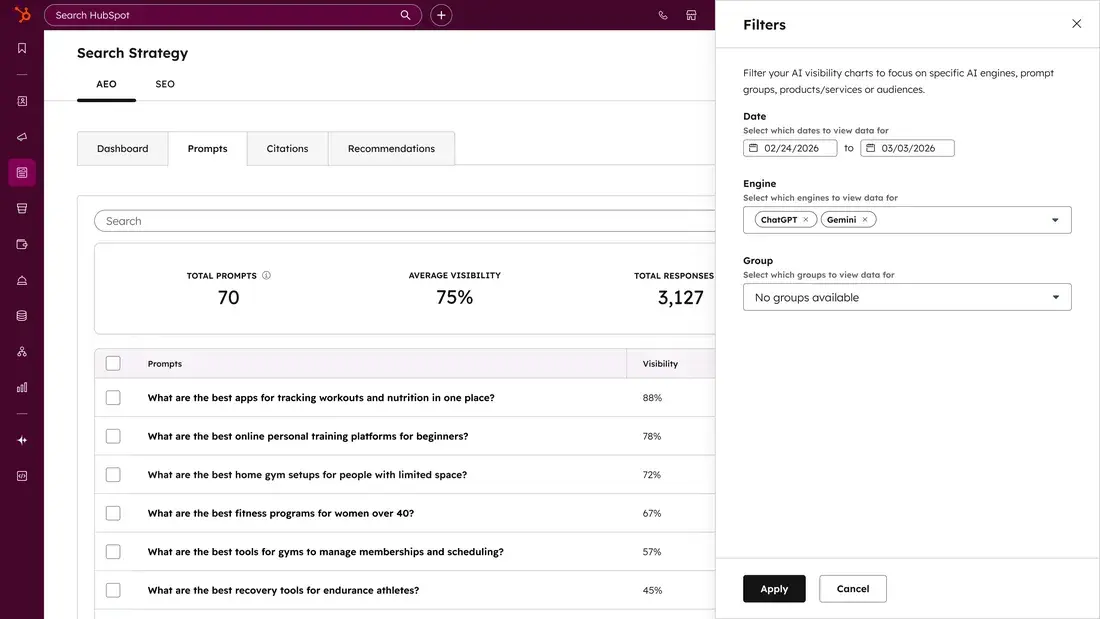
A prompt set is the foundation of AI visibility measurement. It’s a curated list of questions that reflect how your target audience actually searches in AI engines.
Start with 30–50 prompts across three categories:
- Category-level questions: “What’s the best CRM for marketing teams?”
- Problem-based questions: “How do I track my marketing pipeline?”
- Comparison questions: “HubSpot vs Salesforce for small businesses”
2. Input prompts into your AI visibility tool.
Next, you can run your test prompts manually across your desired AI platforms (i.e., ChatGPT, Gemini, etc.), or use a tool like HubSpot AEO, which automatically updates your citations on ChatGPT, Gemini, and Perplexity every day.
But why all platforms? Doesn’t everyone just use ChatGPT?
AI search visibility is no longer a one-platform story. Goodie’s 2026 Wave 2 report found ChatGPT’s share of B2B AI referrals dropped from 89% to 63% in just eight months, while Claude reached 18.5% and Gemini hit 10.6%.
That means prompt tracking needs to happen across all major surfaces:
- ChatGPT: Still the largest single source of AI referral traffic, but share is declining
- Google AI Mode / AI Overviews: Arguably the highest-volume AI surface — tracked via Google Search Console’s AI Mode filter
- Perplexity: Strong in research-heavy and B2B use cases
- Claude and Gemini: Both grew dramatically in 2026 — Claude up 320%, Gemini up 231% year over year.
For a deeper look at how these platforms differ in retrieval logic, citation behavior, and user intent, HubSpot’s guide to AI search engines covers those key distinctions across platforms.
Note: HubSpot AEO doesn’t track Claude or Gemini yet, but you can easily test those platforms manually using a free account.
3. Evaluate and document findings.
Have your citations increased or decreased? How about those of your competitors? Take note of the changes and also record the following;
- whether your brand appears
- where it appears (first mention vs. list item)
- whether the description is accurate.
Every finding can inform your content briefs and strategy, and understanding how your content performs across these AI surfaces will help you identify which pieces drive the most citations and engagement.
How to Identify Competitor Gaps and Close Them With Content
Don’t just look at citations for your website; look at them for your competitors as well.
Running your prompt set for competitors will surface:
- Prompts where they appear and you don’t know which identifies a Content gap to address
- How they’re described compared to how you’re described
- The sources AI engines pull from when citing them, which may be a format or angle you should be creating (i.e., blog post, FAQ page, comparison page, or structured data update)
HubSpot’s research on running AI search experiments offers a useful framework for validating whether new content actually moves citation metrics. Use HubSpot Content Hub to plan, publish, and update that content in one place.
4. Repeat.
Consistency is key. After implementing changes based on insights from your data, plan to run the same prompts again — tracking and analyzing on a consistent schedule. We recommend weekly or biweekly.
How to Connect AI Search KPIs to Conversions and Revenue
This is where most AI search measurement is most important, but also where it usually breaks down.
Marketers can track visibility rate and citation share all day. Still, if those numbers never connect to leads, pipeline, or revenue, they remain on the vanity-metric side of the ledger, and leadership doesn’t fund visibility.
The challenge is that AI search makes attribution genuinely hard. Most AI engines don’t pass referral data. Users discover your brand in a chat window, close it, and later show up as a direct visit or a branded search, with no indication of how they first heard of you. Standard analytics tools weren’t built to capture that path.
That means connecting AI KPIs to conversions requires three parallel approaches:
- Self-Reported Attribution for AI Discovery (Asking people directly)
- Track Branded Search Lift and Direct Entrances (Reading indirect signals)
- Mirroring Key Fields in CRM for Revenue Attribution (Manually tagging contacts as AI-influenced)
None of these is perfect on its own. But together, they build a picture that’s directionally reliable and defensible to leadership.
Use self-reported attribution for AI discovery.
Most attribution models rely on tracking pixels, UTM parameters, or referral headers. AI search breaks all three. A user who discovers your brand through a ChatGPT recommendation and then Googles you directly is invisible to every standard attribution tool — unless you ask them.
That’s why self-reported attribution matters here more than anywhere else in your marketing stack. It’s the only method that captures the zero-click discovery path of someone who learned about you from an AI engine but never clicked a link that GA4 could track.
Add a “How did you first hear about us?” field, with AI engines as explicit answer options, to:
- Lead capture forms
- Post-purchase surveys
- Demo request pages
- Onboarding questionnaires
But is all this extra effort worth it? The data says yes.
A Semrush survey of 1,030 U.S. consumers found that 55% use AI specifically for product research at least weekly. And Fairing confirms the downstream effect: customers naming an LLM in “how did you hear about us” surveys grew more than tenfold from January to mid-July 2025.
Yes, this data is imprecise. People don’t always remember how they first found something. But it catches a real signal that no other method can, and even a rough count of AI-attributed leads gives you something concrete to bring to leadership.
Track branded search lift and direct entrances.
While self-reported attribution tells you where people came from, branded search lift and direct traffic tell you what they do, and often, those behavioral signals are more reliable for predicting purchases.
Here’s the reasoning: someone sees your brand recommended in a ChatGPT or Perplexity answer. They don’t click the citation. They close the chat and type your brand name into Google instead.
When users search for your brand name directly on Google after seeing your brand in an AI answer, that shows up as organic branded search, not AI traffic. Or they navigate directly to your site from memory, and show up in analytics as direct traffic. Neither gets attributed to AI in any standard report.
If your branded search volume rises while your AI visibility improves, that correlation is your attribution signal. It won’t satisfy a last-click attribution model, but it’s honest, directional, and more than enough to support a business case.
To capture it, set up two parallel tracks:
- Google Search Console: Monitor branded query impressions and clicks monthly. Set a clear baseline before you start any AI visibility work, then track month-over-month changes against it.
- GA4 Direct Traffic: Watch for unexplained spikes in direct sessions — particularly in the weeks after content updates, new citations, or improvements in your AI visibility scores.
Set up your CRM to capture AI discovery signals at the contact level.
Without a structure in place, every AI-attributed lead you identify through self-reported forms or surveys disappears into an untagged contact record and never makes it into pipeline reporting. When you set up your CRM to make AI a reportable first-touch source, you can track it the same way you’d track organic search, paid, or referral.
Here’s how. Focus on managing three key contact fields:
- Custom property: “AI Discovery Source.” (Options: ChatGPT, Perplexity, Google AI, Other AI.) This is where the self-reported data from your forms and surveys lives at the contact level.
- Custom property: “First Touch Channel.” This flags whether AI was the first reported touchpoint or a channel that reinforced existing awareness. Useful for separating AI as a discovery driver from AI as a re-engagement nudge.
- Deal attribution: Tag deals associated with AI-source contacts for pipeline reporting. Tagging deals associated with AI-source contacts allows you to run revenue reports, not just lead counts.
Once those fields are populated, the reporting becomes straightforward. You can filter deals by AI Discovery Source, track close rates for AI-sourced contacts versus other channels, and calculate the pipeline contribution of AI-influenced leads over any time period.
HubSpot CRM enables you to easily create custom properties and set up automation to populate fields.
Eventually, this lets you walk into a leadership meeting and say: “AI search influenced $X in pipeline last quarter,” backed by CRM data, not just a visibility score on a dashboard.
Frequently Asked Questions About AI Search Performance KPIs
How do we handle variations in AI answers across users and locations?
AI answers are non-deterministic — the same prompt can return different results across sessions, users, and locations. Reduce the impact by running prompts at the same time of day, from consistent locations (or using a VPN to a fixed region), and by running each prompt multiple times before recording a result. Track trends over 4–6 week windows, not individual sessions.
What if AI platforms don’t provide referral data?
Most don’t — at least not fully. ChatGPT began appending UTM parameters to citation links in June 2025, which helps with web-based tracking. For platforms that don’t pass referral headers, rely on proxy metrics: branded-search lift in Google Search Console, direct-traffic trends in GA4, and self-reported attribution from form fields. Layer these together for a directional picture rather than a precise one.
Which tools should we start with if we’re short on time?
Start with three:
- HubSpot AI Search Grader: Benchmarks your AI visibility across answer engines. Free starting point.
- Google Search Console: AI Mode filter shows impressions and clicks from Google’s AI surfaces.
- GA4 with a custom AI channel group: Captures the AI referral traffic that passes referrer headers.
Add self-reported attribution to your lead forms. That combination covers direct metrics, proxy signals, and early revenue attribution. For a broader toolkit, HubSpot’s guide to AI Search Grader and related AEO metrics covers how to layer these tools together as your measurement practice matures.
How do we prevent vanity metrics from derailing our reporting?
Pair every visibility metric with a business outcome metric. AI visibility rate is only useful next to conversion rate or pipeline data. Citation share is only useful with a competitor comparison. Branded search lift is only useful with a baseline and a time window.
If a metric impresses people in a meeting but doesn’t connect to leads, deals, or revenue, treat it as a supporting signal — not a headline number. The goal is measurement that informs decisions, not dashboards that look good.
Ready to measure your AI search visibility?
Before you can improve your AI search performance KPIs, you need to know where you currently stand.
The HubSpot AI Search Grader benchmarks your brand’s AI search visibility across answer engines in minutes. It shows your citation rate, how you compare to competitors, and where the biggest gaps are — so you have a real baseline to work from, not just a guess.
Want to see it in action first? Request a demo to see how AI Search Grader fits into a full AEO measurement workflow.
Run your benchmark. Set your baseline. Then build from there.