on
Deck & Conn is a cat-and-mouse MicroProse homage to a 55-year-old Star Trek game that might not be chunky enough for today's simulation sickos
I'd still play that PICO-8 prototype, Elissa!
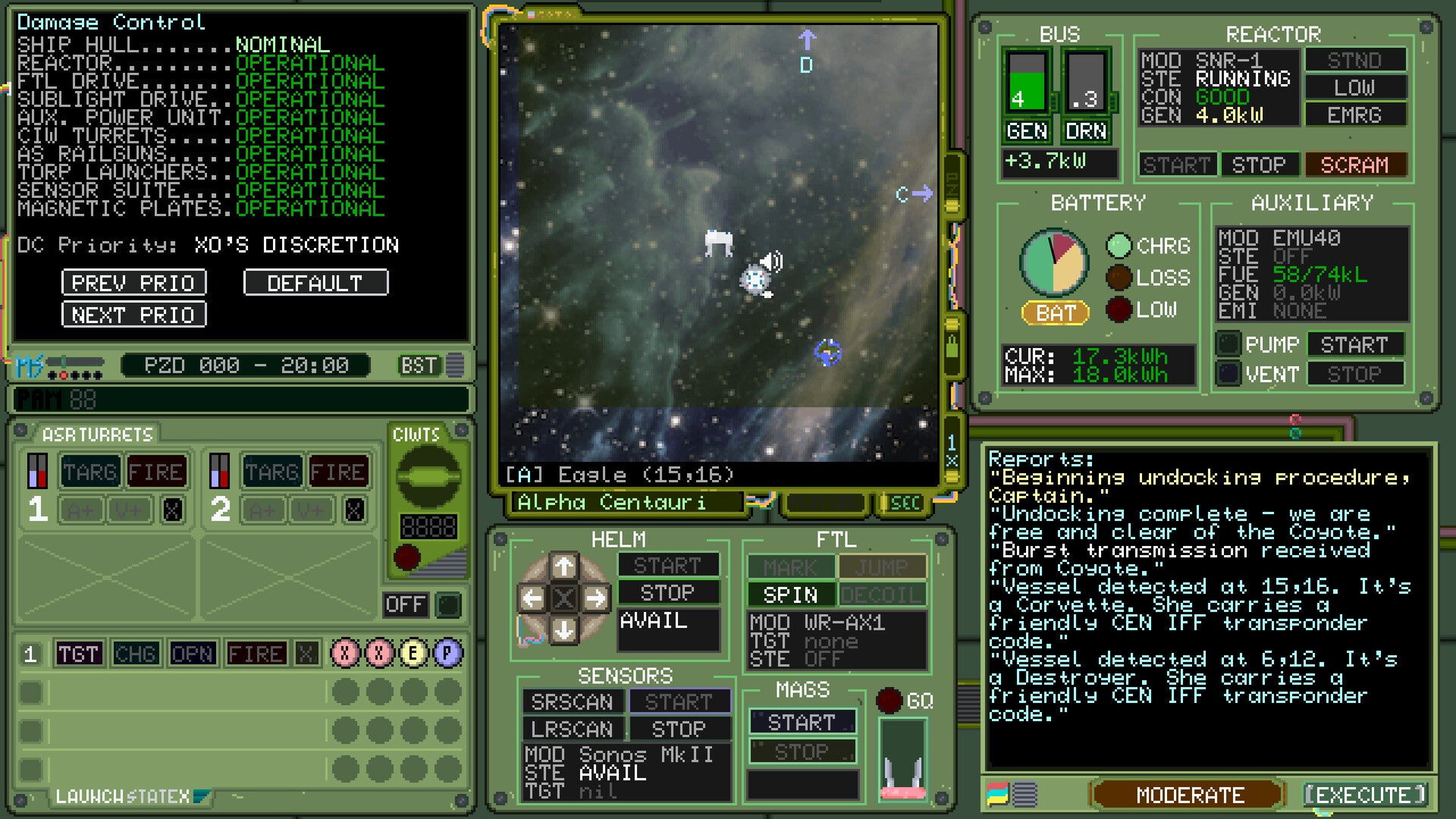
Space! The final frontier. These are the voyages of the USS Rock Paper Enterprise. Or they will be, once I've worked through my launch checklist. OK, says here I start by activating the APU. There's no "APU" on the bridge display, but I'm guessing they mean "auxiliary power unit". Done! Now I have to wait a few turns, then switch on the actual reactor, and spend another couple of turns waiting for it to fill the battery. Now I just activate my helm and sensors, and boom, we're away. Where was I? Ah yes... its five-year mission, to explore strange new worlds! To seek out new life and new civilizations! To boldly go where some very old Star Trek games have gone before!
The game that provoked this abysmal opening sketch is Deck & Conn. Created by Elissa Black of Funtime Electrics and published by Microprose, it's a turn-based space combat simulator inspired by Mike Mayfield's 1971 Star Trek game. Mayfield created the latter on a university mainframe, taking his WIP build home with him on punched tape at the end of every programming session. Imagine it: a computer game that runs on a piece of rolled-up paper you can stuff in your pocket, along with your keys and a decade-old Greggs loyalty card with one unstamped square remaining (don't judge).
Deck & Conn doesn't run on rolled-up paper, though it often feels like it wants to. It's a big chunky composite of securely riveted, khaki green displays, each proudly emblazoned with acronyms that make little sense at first. What is CIWTS? What does it mean to DECOIL my FTL? Your great advantage, certainly by comparison with Black's previous collaboration Objects in Space, is that it's all turn-based. You have all the time you need to figure out the confusing milsymbology, before an enemy captain rocks up to put an EMP through your MAGS.
As in the 1971 Star Trek game, Deck & Conn sees you patrolling quadrants divided into sectors, searching for rogue navies in the course of a grinding forever-war. Having accepted a mission, you'll assign a crew of officers with different experience levels, who determine how fast you'll perform actions such as repairs, and who work rotating shifts. You can "go to general quarters" to summon your senior crew to their stations, but this will eventually exhaust them.
Navigation sees you using sublight engines to move across a grid map space stations, stricken vessels and no-good Klingonites. To FTL to another sector or quadrant, you'll need to reach a cross-hatched warp point. Despite my familiarity with Black's past work, it took me a while to figure all this out, poking various switches on the map screen.
Then begins the creeping cat and mouse game that is each patrol. You'll get hints about enemy movements from Command, via the desktop monitor in your personal quarters (tab right from the bridge display), together with distress calls and other priority intel. You might need to refer to your codebook, before you can read these sensitive messages. More routine hails from passing friendly ships appear in the burst transmission window in top left.

Once you've cornered a hostile sail, it's time to die immediately because you're still learning about the importance of power and sensor management. Top tip: FTL jumps consume a lot of battery power, so if you exit warp right next to a bogey, you're already at a huge disadvantage.
There are broadly two types of weapon in Deck & Conn, based on the hour or two I've played so far. ASR turrets are your regular ship-to-ship guns, dealing less damage but dealing it faster. Torpedoes hit harder (and come in several exciting tactical flavours) but need more preparation. You've got to lock onto the other ship. You've got to load and charge up the individual torpedo. You've got to open the chute. You've got to explode into slag because the enemy captain started their own torpedo checklist two turns before yours.
Deck & Conn has the same claustrophobic, obfuscatory intimacy I enjoyed about Objects in Space. It's somehow thrilling to play a space game in which the spectacle of outer space itself is rudely demoted to a smudgy postcard of stars, and the vaunted feeling 'o' immersion devolves to the hum and whir of the huge cranky void beast that surrounds you. Mind you, I do get the sense that, as it proved with Objects in Space, what's currently here might prove too threadbare and wonky for players who really enjoy their naval simulators.
I can't say management of crew has made a huge impact on me yet, for example. With the extreme caveat that I'm very early on, and haven't added any upgrades to my ship, the combat feels like a deliberate simplification of the Objects in Space approach, lacking a few of the gambits I most enjoyed about that game. Manoeuvring doesn't appear to make much difference, so far, and you can't do tricksy things with your emissions profile to fool enemy sensors. There are also a few stodgy interface elements that are frustrating, rather than engrossing: it appears impossible to cancel certain actions or orders.
Still, some of this leanness is perhaps owing to Deck & Conn being a more direct recreation of a game from 1971. You can read more about how Black made it in this Steam blog, which includes some screens of an earlier PICO-8 version. The latter inspires the horrifying idea that there could be some profitable uncharted overlap between the MicroProsaic interface 'em up genre and the world of twinkly rainbow pixelart. Where is my Cosy cockpit sim, with acronyms made out of sequins and uwus in notifications from Command? Deck & Conn is on sale now.