on
Disturbance has a greater effect on giant kelp productivity than resource availability
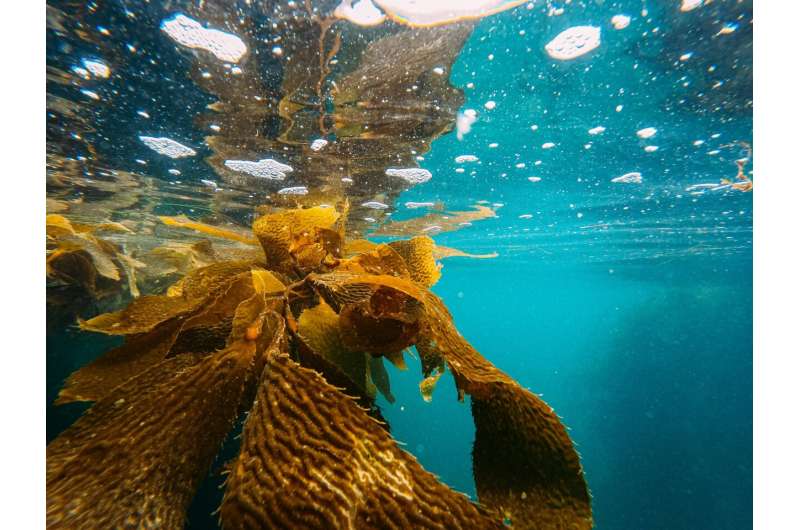
Marine scientists at UC Santa Barbara have found that disturbances to giant kelp forests have a major influence on their net primary productivity (NPP)—an indicator of an ecosystem's health and its ability to support its community—even more so than the availability of the resources needed for growth. Using data from decades of monthly measurements in the kelp forests at the campus's National Science Foundation-supported Santa Barbara Coastal Long Term Ecological Research (SBC LTER) site, the researchers uncovered the direct, indirect and fascinating effects of disturbance on one of the world's most productive ecosystems.
"We found that giant kelp productivity is controlled less by how fast kelp grows and more by how much kelp survives disturbance," said graduate student researcher Billie Beckley, the lead author of a paper published in the journal Ecology. The findings highlight the understudied role of disturbance in controlling ecosystem productivity and may provide insight for conservation and restoration in ecosystems experiencing increased disturbance because of changes in land use and climate.
A disturbance-driven ecosystem
One of the defining features of giant kelp forests is their transience. Unlike many terrestrial ecosystems, which may undergo large-scale disturbances on cycles of decades or more, giant kelp stands experience biomass-removing forces frequently throughout the year. Waves and storms pummel these fast-growing algae, often sending their fronds and spores elsewhere in the nearshore environment to establish other kelp stands anew or to the shore as wrack to nourish nearby beach food webs.
Marine Science Institute senior researcher and co-author Daniel Reed noted the importance of disturbance-driven fluctuations in giant kelp productivity in a 2008 paper that analyzed four years of data collected from kelp forests surveyed by the SBC LTER. The analysis led to a conceptual model of the factors controlling year-to-year variation in kelp productivity.
However, a deeper understanding of kelp ecology comes with long-term monitoring, which allows researchers to observe trends in the kelp's life cycle under a variety of conditions, Reed said. Since the 2008 paper, giant kelp surveyed by the LTER have undergone a major marine heat wave, an explosion of purple sea urchins and episodic burial of reef substrate from shifting sands—all of which have threatened their existence and that of the many animals that rely on them.
"Kelp forests in particular are touted as being one of the most productive ecosystems in the world, yet there really were no time series or datasets on primary production," he said. "You need a high frequency of sampling in these systems because the kelp turns over so quickly."
The seaweed grows so fast, Reed explained, and there is such a high rate of turnover that monthly sampling is required to document the amount of biomass lost during disturbance events. These include not just storm and wave action but also factors such as anomalies in water temperature or predation by sea urchins. This variation is often masked by the seaweed's rapid growth.
Armed with 16 more years of monthly data, the researchers were able to test the conceptual model they developed in 2008 across a wide range of environmental conditions. They built a more nuanced understanding of Southern California's kelp forests and how interannual disturbance affects their net primary production.
They looked at the three main aspects of NPP in kelp: initial production potential, or how much kelp biomass exists at the start of the growing season (late winter/early spring); recruitment of new plants, or how successfully kelp spores settle in a given area; and kelp growth.
"Winter storms strongly shape how productive kelp forests are by removing biomass and changing the forest's ability to recover," Beckley said. Indeed, in their evaluation of the data in their 20-year time series, the researchers attributed the majority of kelp NPP variability to how well kelp survive winter storms, combined with the ability of new plants to establish themselves.
This stands in contrast to typical terrestrial ecosystems, in which the foundation species are more strongly influenced by resource availability. "What typically drives year-to-year variation in productivity in terrestrial systems are factors that affect the growth rate of plants such as temperature, water, nutrients and soil properties," Reed explained.
"We've had some of the warmest events on record with extended periods of very low nutrients, and despite these poor growing conditions, it was really still mechanical disturbance that seemed to drive the variability that we're seeing." The researchers were careful to point out that more intense or more frequent marine heat waves could still have negative effects on the kelp forest's NPP variability.
Their analyses also revealed indirect effects of disturbance on NPP variability and the fine balance struck between disturbance and growth conditions in the kelp forest.
"Winter storms strongly reduce productivity by removing biomass, but they can also indirectly promote productivity by creating space and allowing light to reach the new kelp recruits," Beckley said.
Because giant kelp is a foundational species, the health of the kelp forests dictates the health of the diverse organisms that rely on them. But the effects go beyond the nearshore locations of these kelp stands, which is a major reason why it's important to have a detailed picture of the role of disturbance in their productivity, especially at a time of climate-driven increases in storm intensity, such as the incoming El Niño event, predicted to become one of the strongest on record.
"It's not just that kelp forests are an important ecosystem on our coast; it goes beyond that," Reed said. "Most of the production that happens in the kelp forest doesn't stay in the kelp forest—it gets exported both into deeper water and to the beach where it plays a formidable role in shaping nearshore food webs."
Research in this paper was also conducted by Robert Miller at UCSB; Andrew Rassweiler at Florida State University; Max Castorani at the University of Virginia; and Jarrett Byrnes at the University of Massachusetts Boston.
Publication details
Billie A. Beckley et al, Direct and indirect effects of disturbance on net primary production in giant kelp forests, Ecology (2026). DOI: 10.1002/ecy.70393
Who's behind this story?

Swati Mestri holds a bachelor's degree in Electronics Engineering and has worked as a content editor since 2019. She has experience editing research documents across technology, health care, and materials science, and has a particular interest in technology and space. Full profile →

Master's in physics with research experience. Long-time science news enthusiast. Plays key role in Science X's editorial success. Full profile →
Citation: Disturbance has a greater effect on giant kelp productivity than resource availability (2026, July 14) retrieved 14 July 2026 from https://phys.org/news/2026-07-disturbance-greater-effect-giant-kelp.html
This document is subject to copyright. Apart from any fair dealing for the purpose of private study or research, no part may be reproduced without the written permission. The content is provided for information purposes only.