on
Epic boss Tim Sweeney says the EU's social media ban for under-13s 'would be terrible for the next generation of humanity'

XEpic Games CEO Tim Sweeney says the European Union's plan to restrict social media use by children, including a complete ban for anyone under the age of 13, is "terrible for the next generation of humanity" because of the impact it will have on the growth of creativity and expression.
Announced today, the EU KIDS Act—"Keeping Internet Digital Spaces Accountable and Trustworthy," because overwrought acronyms for serious legislation isn't a uniquely American phenomenon—imposes a blanket ban on social media accounts for anyone under the age of 13, although "specially-designed child-friendly video-sharing services" can be established via their parents' or guardian's accounts.
From the ages of 13 to 15, accounts can be set up under the supervision of guardians, although they should have "limited features and screen time." From 15 up, minors can set up their own "autonomous accounts" without parental consent, although "parental guidance remains essential during this stage."
The goal of the new regulations is to effect a "gradual approach" to social media use—the digital equivalent of teaching kids to swim before throwing them into the lake. Notably, the KIDS Act covers not just traditional social media platforms—Instagram, TikTok, and the like—but also "video-sharing platforms, online games, AI chatbots or companions," plus app stores and operating systems. Some services, like online encyclopedias, educational platforms, and digital news outlets, would be exempt.
"Today, our children are engaging with the most sophisticated technologies ever created. Technology that was never created with their wellbeing in mind," EU president Ursula von der Leyen said in a statement. "Our KIDS Act is reversing the burden of proof—it is for platforms to show they are safe by design. And we put parents back in the driving seat, giving them the tools to help their children navigate a safer online world."
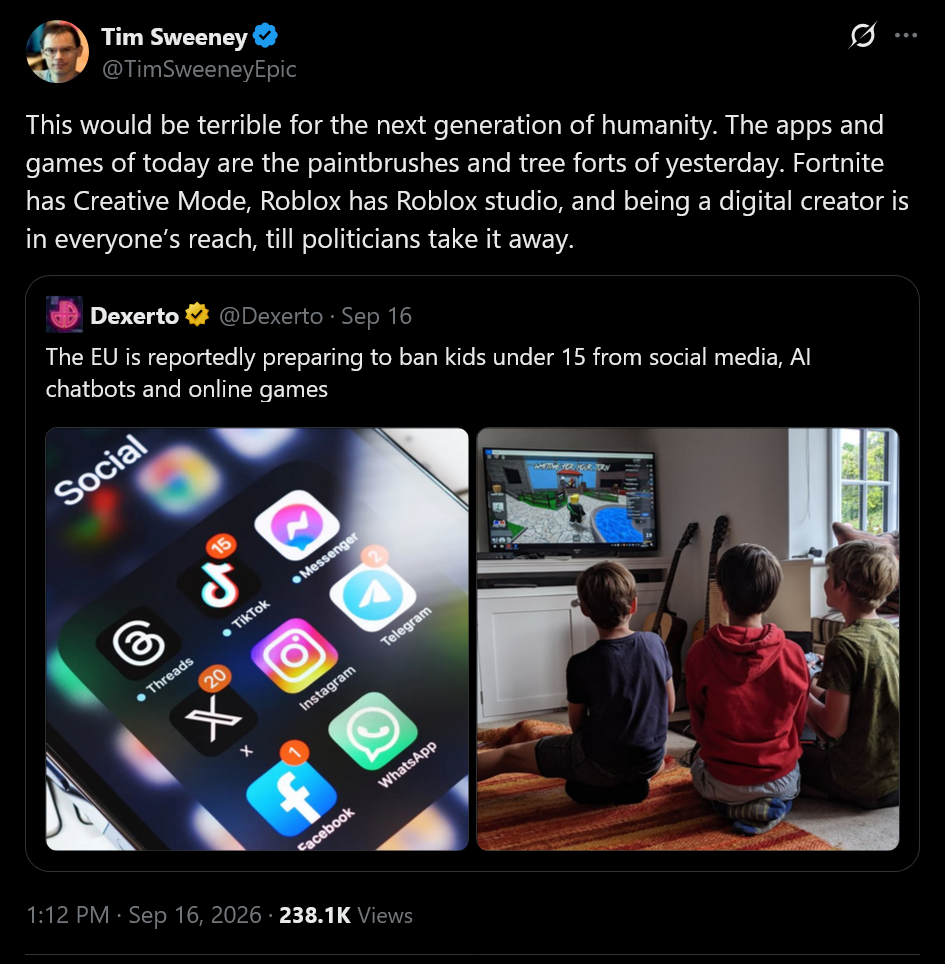
Sweeney takes a different view of the situation, however. "This would be terrible for the next generation of humanity," the Epic chief said on X, a day prior to the act's official announcement. "The apps and games of today are the paintbrushes and tree forts of yesterday. Fortnite has Creative Mode, Roblox has Roblox studio, and being a digital creator is in everyone's reach, till politicians take it away."
It's fair to say that it would not be great news for Epic if the EU suddenly made it a whole lot harder for kids under 15 to play Fortnite, and without wanting to sound like an 'in my day we drank straight from the hose!' guy, I would point out that paintbrushes and tree forts are still readily available. It's not as if pre-teens will be reduced to cave painting and hitting each other with rocks if they're suddenly no longer able to generate content for billionaires.
From the creators of Edge: A free weekly videogame industry newsletter, featuring in-depth news, expert analysis and exclusive interviews
Even so, I find myself on board with Sweeney's broader stance—this isn't a great idea—not out of concerns that it will dull the creative instincts of the next generation, but simply because it's a potential security and privacy nightmare that's difficult to enforce and may or may not achieve its stated goals anyway.
And as other PC Gamer writers have previously pointed out, the impact of social media on young minds is only part of the problem, and arguably a relatively minor part: It also bakes the brains of adults with startling efficiency.
The EU KIDS Act is not a done deal. The proposed regulation has been submitted to the European Parliament and Council, and from there will enter the legislative process required for approval. Given the recent enactment of social media bans for kids and online age verification requirements in Australia, the UK, and some US states, though, and "the clear demand for urgent and comprehensive action" expressed by the EU, I expect it will be soon enough.
Andy has been gaming on PCs from the very beginning, starting as a youngster with text adventures and primitive action games on a cassette-based TRS80. From there he graduated to the glory days of Sierra Online adventures and Microprose sims, ran a local BBS, learned how to build PCs, and developed a longstanding love of RPGs, immersive sims, and shooters. He began writing videogame news in 2007 for The Escapist and somehow managed to avoid getting fired until 2014, when he joined the storied ranks of PC Gamer. He covers all aspects of the industry, from new game announcements and patch notes to legal disputes, Twitch beefs, esports, and Henry Cavill. Lots of Henry Cavill.