on
26 years ago, this surreal six-episode sci-fi masterpiece changed anime forever
Follow
Link copied to clipboard

Published Jul 26, 2026, 8:30 AM EDT
The coming-of-age story that never gets old
Before False Memory arrives, binge the six-episode anime that changed a generation
 Image: FLCL Production Committee
There are plenty of reasons to be excited for Chinese animation studio Flint Sugar's upcoming donghua False Memory, which streams for free on YouTube next month. From the pedigree behind it (Shuyu Li and Wenyu Liu are the dynamic duo of China’s indie 2D animation movement and the co-founders of Flint Sugar studio) to the promise of an introspective coming-of-age story wrapped in surreal science fiction, False Memory already feels like one of the most intriguing anime on the near horizon. But while this story of a young boy who stumbles upon a surreal universe using a time-altering device looks to be every bit promising in its delivery, as a long-time anime fan, I can’t help noticing similarities it shares with another series that's well over two decades old.
These two shows somehow seem to speak the same language. Both portray adolescence as something messy, confusing, and almost impossible to explain with ordinary reality. The only way to capture growing up is through tower-sized metaphors, impossible technology, or visitors from somewhere beyond our understanding. Long before False Memory existed, a six-episode series by Gainax (the famed anime studio behind Neon Genesis Evangelion, Gurren Lagann, and Gunbuster) perfected this idea with one of the most defining OVAs in existence.
It's difficult to overstate just how singular FLCL (short for Furikuri, or "Foolycooly" in English) felt in 2000. Directed by Kazuya Tsurumaki and written by Yōji Enokido — collaborators who would go on to create Mobile Suit Gundam GQuuuuuuX and Diebuster — the story follows a 12-year-old boy named Naota Nandaba whose uneventful life is upended when he's struck by a guitar by an eccentric woman who claims to be a space pirate. Yes, it's as absurd as it sounds. FLCL displays the same kind of wonderful insanity that a story a 12-year-old might dream up, and it gets even crazier as robots erupt from the boy's forehead, guitars turn into weapons, and a Vespa takes flight, all while a giant iron-shaped factory looms over his sleepy hometown. Even more fascinating is how the adults behave with the emotional maturity of children, while the town’s actual children are forced to navigate feelings they barely understand.
Somehow, it all makes perfect sense. That's FLCL’s greatest trick. It builds a world that's almost comical in nature, asking you to accept impossible rules without ever dwelling on them. The bizarre simply exists, freeing the series to focus on the underlying themes of adolescence, the awkwardness of growing up, the frustration of feeling trapped in a town that never changes, and the desire to become someone older before you've figured out who you truly are.
 Image: Production I.G.
Like Neon Genesis Evangelion before it, FLCL centers on a protagonist who resents the world around him as much as he resents himself. Naota carries that same detached cynicism Evangelion protagonist Shinji Ikari is often remembered for, but the two stories ultimately arrive at different destinations. Where Evangelion spirals inward with self-loathing and existential doubt, FLCL bursts outward. Beneath its electric guitars, human-like robots, slapstick humor, and visual chaos is an unexpectedly optimistic story about embracing change instead of fearing it. FLCL asks you to stop pretending you've already grown up and simply let yourself become the person you're meant to be.
Maybe that's why it's remained one of my favorite anime all these years later. Every rewatch reveals another emotional beat I'd overlooked beneath the noise. FLCL characters I once found irritating — like Mamimi, Eri Ninamori, and even Atomsk — suddenly become sympathetic. Conversations that once felt random reveal surprising vulnerability. Every single time you return, FLCL finds a way to make you feel something you haven’t felt in years.
Mirroring Shinichiro Watanabe’s Cowboy Bebop and Samurai Champloo, FLCL features a soundtrack that embeds itself into the narrative. As a massive fan of the Japanese alt-rock icons, The Pillows, director Tsurumaki chose his favorite tracks to score the series, providing an energetic, punk, and garage-rock feel that effortlessly uplifts every scene. The band's fuzzy alternative rock becomes the show's heartbeat, turning quiet conversations into moments of longing and explosive action scenes into emotional crescendos.
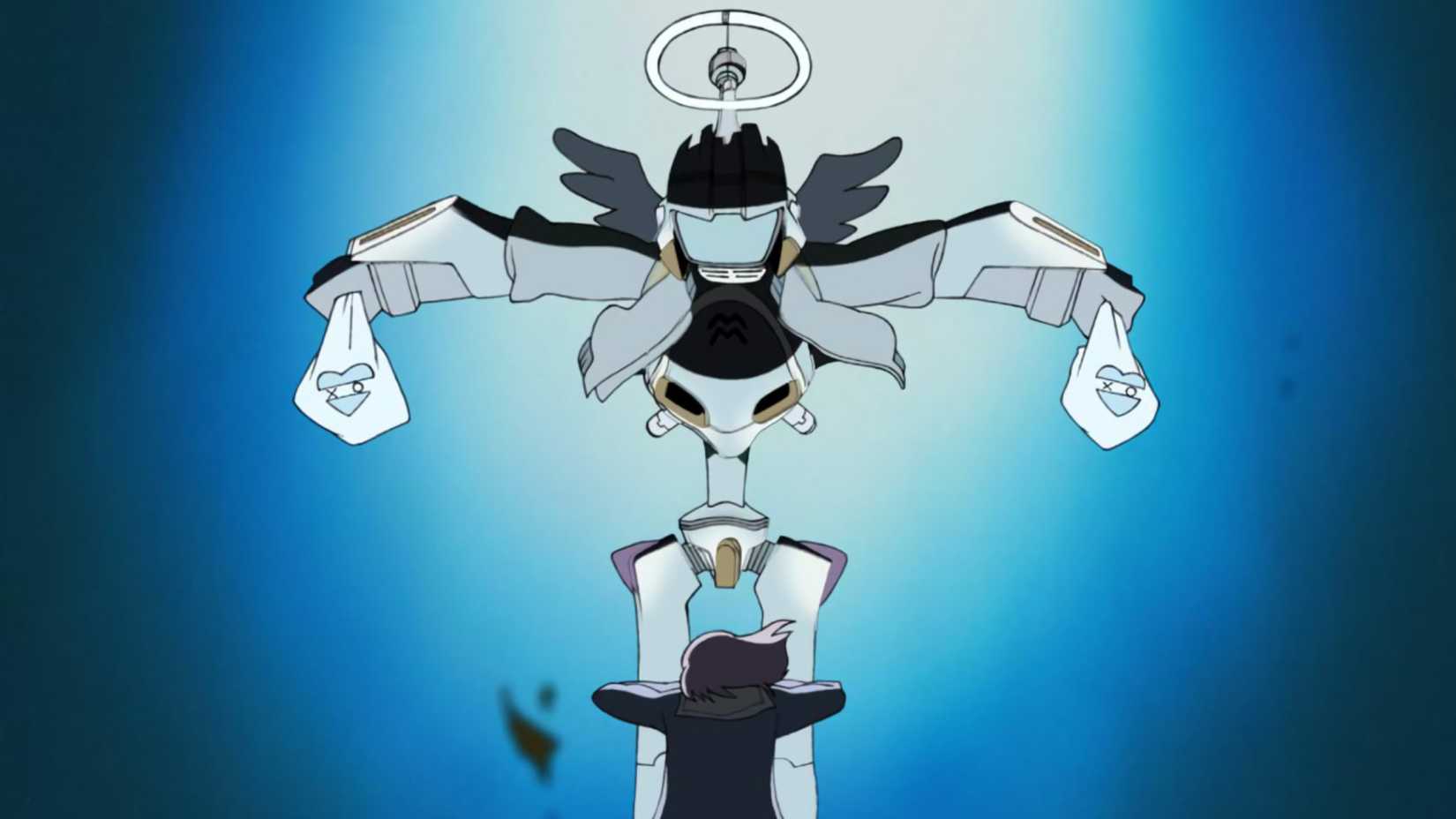 Image: Production I.G.
That sonic resonance is what allowed FLCL to slot so naturally into the AMV (anime music video) format at the time — and none of them were as memorable as the now-legendary, 19-year-old Fuel “Shimmer” AMV that likely introduced me to the show in the first place. FLCL didn’t spread across the internet in quite the same way as something like Serial Experiments Lain, but it still became inseparably linked with the early days of online anime fandom. Before streaming made discovering new series effortless, shows like FLCL lived through word of mouth, fan edits, message boards, and the homemade videos that helped introduce entire communities to new worlds. (You can still watch the original VHS rip on Internet Archive today.)
That connection feels especially fitting considering how much FLCL helped define anime at the turn of the century. It arrived at a moment when the medium was expanding beyond its traditional boundaries, blending experimental animation, alternative music, and deeply personal storytelling in a way that felt unlike anything else on television. Its influence can still be felt today, including in projects like False Memory, which appears to share some of FLCL's fascination with adolescence, surreal imagery, and the emotional chaos of growing up.
Arriving just two days before the 23rd anniversary of FLCL's release in the United States, False Memory feels like a fitting reminder of how much that era of anime continues to inspire creators today. Whether it captures the same lightning-in-a-bottle energy or simply carries forward some of those ideas remains to be seen, but it exists because stories like FLCL proved anime could be strange, intimate, experimental, and still deeply human all at the same time.
That's always been the magic of FLCL. It's one of the greatest six-episode anime you'll ever binge, but more importantly, it's proof that when music and storytelling move in perfect harmony, particularly in relation to poignant themes of adolescence, they can leave an impression that lasts longer than a lifetime.
FLCL is available to stream on HBO Max and Crunchyroll.