on
I Tested The New Porsche Cayenne EV's 400-kW Charging, And Even Without Reaching The Peak It's Fast As Hell - Jalopnik
Chris Tsui/Jalopnik
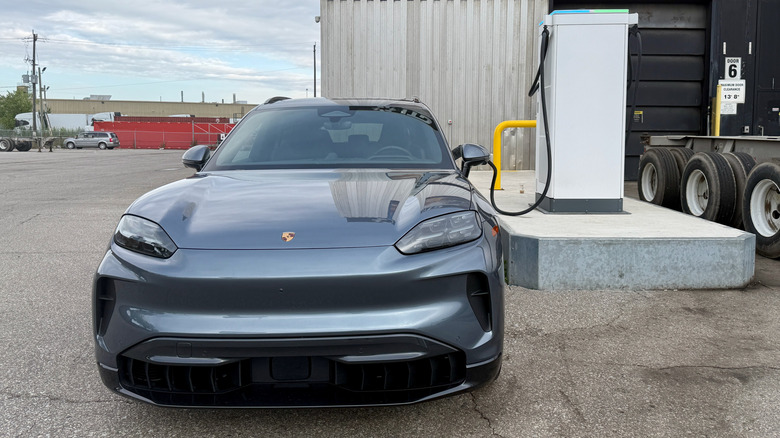
Other than having a 1,139-horsepower Turbo variant that can stay in front of a 918 Spyder 'til about 120 mph, one of the more notable speed-related flexes of the new Porsche Cayenne Electric is its ability to DC fast charge at speeds of "up to 400 kW," and its claimed 10%-to-80% charge time of just 16 minutes. I had my hands on a base model Cayenne EV for a week recently — it's quietly sublime to drive, quietly sublime to be in, and both my partner and I now want one — and decided to put that 16-minute claim to the test.
For the record, a lot of Porsche's marketing copy says this car is capable of 400-kW charging, but digging deeper into the spec sheet shows an actual max DC rate of 390 kW. Even so, this puts it in the upper echelon of the fastest-charging EVs on the market right now. The Volvo EX60 and Lucid Gravity can do 400 kW, as can BMW's new iX3 and i3. The Mercedes-AMG GT 4-Door is said to be capable of 600 kW while the Cayenne's platform sibling, the upcoming Bentley Torcal, will also charge at 400 kW. But other than that, the handful of EVs that can do more than 400 kW are mostly Chinese.
And as far as electric Porsches go, the new Cayenne Electric should be the quickest-charging one so far. For comparison, the Macan Electric tops out at 270 kW, while the Taycan has a ceiling of 320 kW.
Destination charging
Chris Tsui/Jalopnik
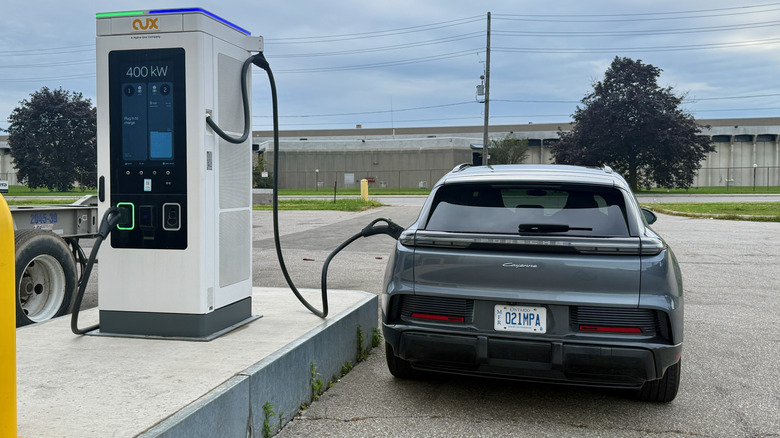
As of this writing, 400-kW public chargers remain an uncommon sight, at least in North America. And as far as I can tell, there is only one in the entire Greater Toronto Area where I'm based: an Ivy-operated station located in the loading area of a semi-trailer manufacturer in a nondescript, west end industrial park. It costs $0.80 CAD per kWh, and the Cayenne's battery holds 113 kWh of juice, so the fill-up wouldn't be cheap.
I rolled up to this charger with 13% left in the battery and a phone with the Ivy app already installed, credit card info loaded and ready to go. Getting the charge going was relatively painless. The Cayenne has a Tesla-style NACS port for DC fast-charging, and this charger uses CCS, but Porsche supplied an adapter that popped right onto the plug and worked as advertised.
For reference, it happened to be a pretty optimal and comfortable 68 degrees Fahrenheit at the time of this test, although Porsche says its claimed charge time should hold up "even on very cold or hot days."
Port chrono
Chris Tsui/Jalopnik
After charging began, it took precisely 22 seconds for the rate of charge to rise and hit 349 kW (practically the max of most other charging stations from, say, Electrify America). The car gets super loud when it's recouping energy this hard, sounding like there are several giant fans underneath it keeping the battery cool. The Cayenne Electric features double-sided battery cooling that keeps both the top and bottom of the battery chill, and the system is said to have the same cooling capacity as about 100 large household refrigerators.
Things pretty much stayed around the 350-kW ballpark until the state of charge approached 50% just seven minutes later. Charging speed then gradually dropped and hovered around 270 kW, the absolute max you'd get from this car's little Macan sibling.
About nine minutes after that (16 minutes into the experiment total), the car was quickly closing in on 80%, and charge speeds were now around 200 kW. So, there you have it: 13% to 80% charge in 16 minutes. I'd estimate truly starting from 10% would've added just a minute, tops, to this time, because for what it's worth, 13% to 83% took just 18 minutes total (charging speed dropped further past 80%). All in all, it's an impressive result that gets meaningfully close to the manufacturer's claimed specs.
No, at no point did I actually observe 390 kW, let alone 400 kW, but even still, if all EVs and all charging stations charged this quickly, electric car ownership as an idea would likely feel a lot more feasible for many folks, even if that's from a psychological, road-trip edge-case perspective. Sixteen minutes, by the way, is way less time than it takes for me to use the washroom, have a snack, and hit a lil' IG Reels scroll.
Still cheaper than gas?
Chris Tsui/Jalopnik
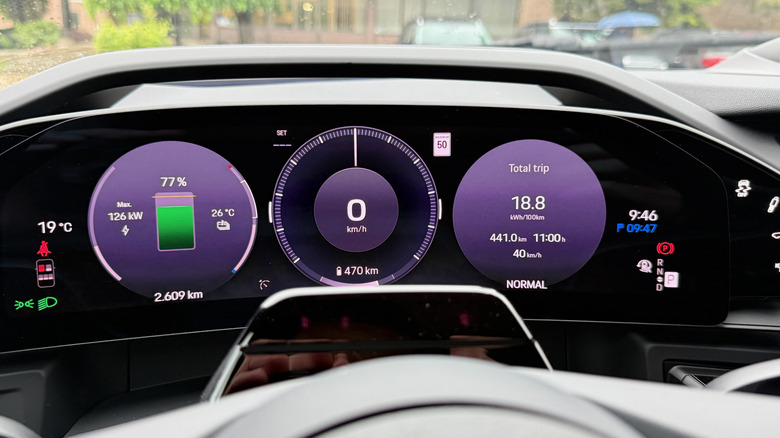
In the end, this 19-minute charge dispensed 85.2 kWh of energy and cost $68.16 CAD, or about $50 USD at today's exchange rates. Given my average observed efficiency figure of 18.8 kWh per 100 km over the course of my time with the Cayenne, this works out to about $0.18 USD per mile of range recouped.
On the day I happen to be writing this, the national average price of premium fuel in the U.S. is $5 per gallon, according to AAA. Given that the gas-powered, 468-hp, $108K Cayenne S is arguably the closest apples-to-apples comparison and is EPA-rated for 18 mpg combined, every mile in that car would theoretically cost $0.28 in gas.
So, yes, even at premium DC fast-charging prices, electricity is still notably less expensive than gas on a per-mile basis when comparing similar-enough cars. If only there were more 400-kW chargers around to make that 16-minutes-to-80% thing more accessible.