on
Melting icebergs can weaken a massive, far-off ocean current system
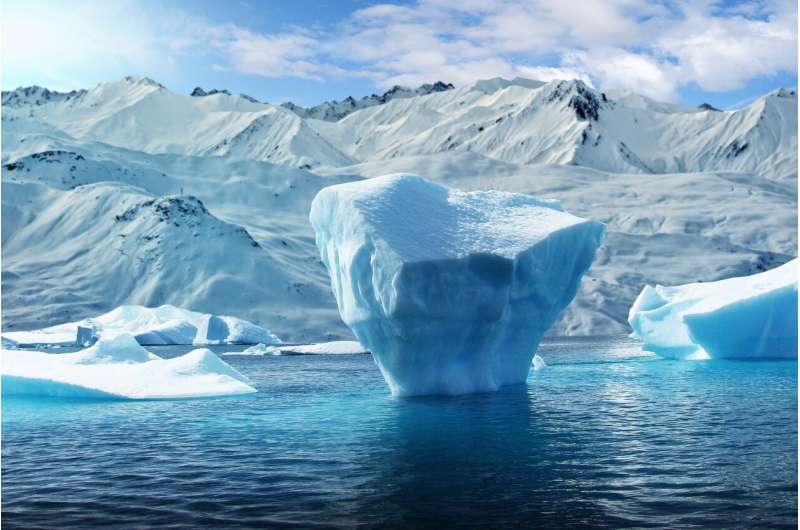
Melting and breaking icebergs in the far-off northeastern Pacific Ocean can weaken a massive current system in the Atlantic Ocean, according to a University of California, Davis study published in Nature Communications.
The Atlantic Meridional Overturning Circulation, or AMOC, regulates the global climate by acting as a massive conveyor belt, moving warm, salty water from the tropics to the North Atlantic. AMOC is responsible for 70% of oceanic heat transport across the equator and influences the global climate by redistributing heat and energy.
Melting icebergs in the North Atlantic Ocean were previously considered the primary drivers of AMOC weakening during Earth's last ice age, leading to global climate shifts, including cooling in the Northern Hemisphere and warming in Antarctica. Scientists refer to these events and their time periods as Heinrich stadials.
"More recently, however, scientists have found that these North Atlantic iceberg melting events happened after the AMOC was weakened and Greenland was cooled," said lead author Chijun Sun, an assistant professor in the UC Davis Department of Earth and Planetary Sciences. "So the iceberg discharge events in the North Atlantic could not have driven AMOC weakening."
For the study, Sun and his colleagues recreated these events using paleoclimate data and supercomputer simulations. They found that the more likely culprits influencing Heinrich stadials are iceberg discharge events—in which large amounts of ice break from a glacier or ice sheet—and meltwater from the northeastern Pacific Ocean.
"We found that North Pacific iceberg discharge events correlate very well with the onset of Heinrich stadials," Sun said. "What's more, they consistently lead to North Atlantic iceberg discharge events, so there might be a causal relationship there that has not been explored."
The research provides a chronology for how modern iceberg discharge events and meltwater could influence AMOC.
Simulating the Earth 19,000 years ago
In the study, the researchers simulated Heinrich stadial 1, a deglaciation event that occurred roughly 19,000 years ago.
During that time, sea levels were about 390 feet lower than today (119 meters), a massive ice sheet about 10,000 to 16,000 feet thick (3,000 to 4,900 meters) covered North America, and atmospheric concentrations of carbon dioxide were around 180 parts per million, compared with today's roughly 430 parts per million.
The team's simulations showed that freshwater from northeastern Pacific iceberg discharge events made its way across the globe to the North Atlantic deepwater formation regions, where dense surface waters sink to drive the AMOC engine.
This influx of warm freshwater diluted AMOC waters, leading to subsurface warming, subsequent weakening and further release of iceberg meltwater from the North Atlantic.
"What is novel and surprising here is that North Pacific meltwater could independently drive AMOC weakening, offering a new paradigm for the trigger of Heinrich stadials," Sun said.
Such subsurface warming can affect the West Antarctic Ice Sheet.
"We know that the subsurface warm water is causing rapid retreat of the West Antarctic Ice Sheet," Sun said. "It was the same mechanism that drove some of the ice sheet retreat during the last deglaciation."
Meltwater influences the global climate
Sun said there's strong consensus among scientists that AMOC will weaken by the end of the 21st century. Some even predict a total collapse of the system.
Previous research by Sun and his colleagues linked future AMOC weakening to significant reductions in precipitation over some of Earth's rainiest places, including Central America, the Amazon and West Africa. In some areas, annual precipitation was nearly cut in half.
The current research further emphasizes that AMOC is sensitive to events across the global ocean. "It's not only sensitive to whatever happened over the North Atlantic," Sun said. "It can be sensitive to any freshwater discharge."
Publication details
Chijun Sun et al, North Pacific meltwater weakens the Atlantic Meridional Overturning Circulation and preconditions Heinrich Stadial 1, Nature Communications (2026). DOI: 10.1038/s41467-026-75199-y
Who's behind this story?

BA art history, MA material culture. Former museum editor, paramedic, and transplant coordinator. Editing for Science X since 2021. Full profile →

Master's in physics with research experience. Long-time science news enthusiast. Plays key role in Science X's editorial success. Full profile →
Citation: Melting icebergs can weaken a massive, far-off ocean current system (2026, July 13) retrieved 13 July 2026 from https://phys.org/news/2026-07-icebergs-weaken-massive-ocean-current.html
This document is subject to copyright. Apart from any fair dealing for the purpose of private study or research, no part may be reproduced without the written permission. The content is provided for information purposes only.