on
Trump-led board reportedly votes again to close Kennedy Center for renovations – live
From
1h agoTrump-led board reportedly votes again to close Kennedy Center for renovations
The board of the John F Kennedy Center for the Performing Arts has once again voted to move forward with Donald Trump’s controversial plan to temporarily close the building for renovations, the New York Times (paywall) is reporting, citing two people with direct knowledge of the proceedings.
The decision will be subject to approval by a federal judge. In May, US district judge Christopher Cooper issued a temporary block on Trump’s demand to close the arts institution for two years of renovations, which was due to start in July after the board – mostly handpicked by the president – voted unanimously in favor. But Joyce Beatty, a Democratic US representative of Ohio who sits on the board, sued over the decision.
Cooper shut down the plan on the basis that “in ratifying President Trump’s closure announcement, the Board was derelict in discharging the full range of its responsibilities to the Center”.
“More specifically, the Board based its decision on an insufficient, one-sided presentation of information and neglected to consider the full range of its statutory obligations and potential adverse consequences of closure on programming and memorial functions,” Cooper went on.
He called the decision to halt operations during the renovation “ill-informed and seemingly preordained”.
According to the New York Times’s report, the board voted today “to close the Kennedy Center’s main building, while keeping a newer addition to the campus, known as the Reach, open for limited programming and to operate as an active memorial to John F. Kennedy.”
double quotation markAhead of the meeting, the board was presented with a 163-page plan for a $250m “renewal” project that includes structural repair work, new marble floors, $11.8m in “acoustical improvements” and a plan to temporarily move the famous 3,000-pound bronze bust of Kennedy to another building on campus.
Board members were provided with a comparison of two scenarios for renovations by an outside consultant. Both the consultant and the construction management firm, JLL, raised safety and cost concerns that they say would arise from keeping the building open during a phased renovation.
The proposal by JLL says the project would address chronic leaks, replace outdated equipment and redesign parts of the interior. Changes include new furniture, a new coffee shop, electronic ticketing kiosks and $7m in public restroom renovations. The target for reopening would be summer of 2028.
Judge Cooper said in his order that the board had a legal obligation to maintain the facility as a memorial to President Kennedy. Under the plan, memorial materials would be moved to a newer addition to the campus during the closure.
It was unclear immediately after the meeting, which was held virtually and was not public, whether the center intends to pursue the exact plan laid out in the report following the judge’s review.
The Kennedy Center has until next week to share its plan with Cooper, who will review his decision to consider whether the board carried out sufficient due diligence ahead of the vote.
We’ve reached out to the Kennedy Center for comment.
Key events
25m ago
Leavitt's resignation creates a list of possible successors for top position
1h ago
Todd Blanche urges justice department to work as 'one team' in first speech as attorney general
1h ago
Trump-led board reportedly votes again to close Kennedy Center for renovations
2h ago
Judge dismisses Trump administration lawsuit alleging Harvard failed to protect Jewish students
3h ago
Pete Hegseth downplays conditions on USS Abraham Lincoln after reports of food shortages and a mental health crises on board
6h ago
Max Miller’s ex-wife sues him for ‘recklessly’ publishing an image of their daughter as part of custody battle
7h ago
Karoline Leavitt steps down as White House press secretary three months before midterms

Marina Dunbar
A Guatemalan immigrant detained by US Immigration and Customs Enforcement (ICE) at a Newark, New Jersey, facility suffered a medical emergency and later died after being hospitalized, according to the Trump administration.
José Chajón-Raxón is the third immigrant to die after being held at Delaney Hall, an ICE detention center that reopened in May 2025 amid the Trump administration’s immigration crackdown.
A nurse responded when Chajón-Raxón experienced a medical emergency and “witnessed Chajón-Raxón experiencing seizure-like activity”, according to the Department of Homeland Security (DHS). Medical personnel were called, and he was transported to a hospital, the DHS said in a statement shared with the Guardian.
ICE agents had arrested Chajón-Raxón before bringing him to Delaney Hall on 18 July, the agency said. Four days later, Chajón-Raxón was “released from ICE custody on July 22”, according to the agency, which did not provide further details about the circumstances of his release.
Key questions about what happened next remain unanswered in the DHS account. The department did not say what occurred after Chajón-Raxón arrived at the hospital, whether he left the hospital before his death or exactly when he died.
“Per ICE policy, when an individual is no longer in ICE custody then ICE will no longer be responsible for monitoring or reviewing deaths that may occur. This is common sense,” the DHS statement said.
The case comes after a policy shift announced earlier this year under which the agency stopped reporting deaths occurring within 30 days after a person is released from custody. That change reversed a policy put in place by the Biden administration in 2021.
Leavitt's resignation creates a list of possible successors for top position
Leavitt’s surprise resignation as the White House press secretary may trigger a sharp-elbowed race inside Trump world for one of the administration’s most prominent positions.
Several names have circulated since Donald Trump announced that Leavitt would be stepping down at the end of the month to spend more time with her family. Here are a list of just some of the possible contenders.
-
Stephen Cheung – Cheung currently serves as the White House communications director, and has worked closely with Leavitt throughout the second Trump administration. When he praised the outgoing press secretary for her tenure on Wednesday, Leavitt joked on social media that the pair had survived “many, many news cycles” together.
-
Alina Habba – Habba is a loyal ally of the president who previously served as his personal lawyer before becoming the short-lived the US attorney for New Jersey. A federal judge ultimately ruled her appointment was unlawful. But Habba has been one of the president’s most vocal defenders on conservative outlets. According to the New York Post, citing sources within the administration, Habba is an early frontrunner to replace Leavitt.
-
Anna Kelly – Kelly already works at the White House as the principal deputy press secretary, working under Leavitt. She was previously a spokesperson for Trump’s 2024 presidential campaign, and before that she serves as national press secretary for the Republican National Committee.
-
Katie Miller – As the wife of top White House aide and immigration policy architect Stephen Miller, she has a front row seat to the administration’s movements. And as an influential conservative podcast host, Miller has spent a lot of time interviewing cabinet officials and right-wing media figures. Prior to launching her podcast, Miller was a communications director for the so-called Department of Government Efficiency (Doge). She was vice-president Mike Pence’s press secretary from 2019-2021.
-
Taylor Budowich – Budowich is a former White House deputy chief of staff, who worked alongside Miller and Dan Scavino, who left the White House last year to join the private sector. Alongside Leavitt, Budowich was one of the defendants in the case brought by the Associated Press after the outlet was banned from the press rotation for refusing to refer to the Gulf of Mexico as the “Gulf of America”.
Todd Blanche urges justice department to work as 'one team' in first speech as attorney general
Todd Blanche, the newly confirmed attorney general, called on the justice department to work as “one team” with “one mission” in his first speech at the department headquarters in Washington DC, after his swearing-in ceremony this week.
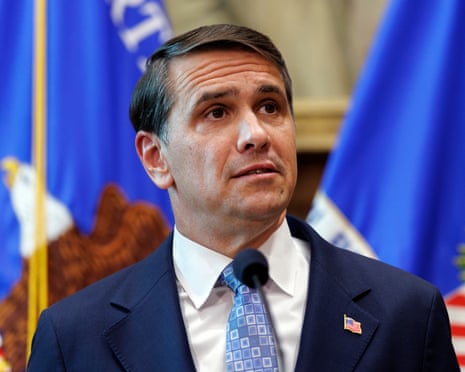
Blanche secured his nomination narrowly last week, after some Republican senators said his decisions while serving as acting attorney general gave them little confidence he would act independently. Lisa Murkowski and Susan Collins – two moderate lawmakers – cited Blanche’s decision to greenlight a $1.8bn so called “anti-weaponization fund” to compensate Donald Trump’s allies – as part of their decision to vote against his confirmation.
“Everything that I do will not be the right path or the right decision,” Blanche said today. “But I do promise you this: I promise you that I will work as hard as any of you. I promise that I’ll listen to you. That I will listen to the ideas that you have, or adjustments that we need to make, and if we need to make them, I will make them.”
Critics have said that Blanche’s takeover will only contribute to the justice department’s politicization in the second Trump administration, as the president continues to target his perceived political enemies.
The new attorney general told the workforce – which includes the FBI, Drug Enforcement Agency (DEA) and the Bureau of Alcohol, Tobacco, Firearms and Explosives (ATF) that the department has he is proud of the department’s work tackling violent crime and illegal drug trafficking.
“It’s easy to focus on the negative or the news story that is critical of something we’re doing or something that we’ve done, or questions something that we’re doing or something that we’ve done,” Blanche said. “But do not forget that we have accomplished a tremendous amount of good, positive work in the past year and a half.”
Trump-led board reportedly votes again to close Kennedy Center for renovations
The board of the John F Kennedy Center for the Performing Arts has once again voted to move forward with Donald Trump’s controversial plan to temporarily close the building for renovations, the New York Times (paywall) is reporting, citing two people with direct knowledge of the proceedings.
The decision will be subject to approval by a federal judge. In May, US district judge Christopher Cooper issued a temporary block on Trump’s demand to close the arts institution for two years of renovations, which was due to start in July after the board – mostly handpicked by the president – voted unanimously in favor. But Joyce Beatty, a Democratic US representative of Ohio who sits on the board, sued over the decision.
Cooper shut down the plan on the basis that “in ratifying President Trump’s closure announcement, the Board was derelict in discharging the full range of its responsibilities to the Center”.
“More specifically, the Board based its decision on an insufficient, one-sided presentation of information and neglected to consider the full range of its statutory obligations and potential adverse consequences of closure on programming and memorial functions,” Cooper went on.
He called the decision to halt operations during the renovation “ill-informed and seemingly preordained”.
According to the New York Times’s report, the board voted today “to close the Kennedy Center’s main building, while keeping a newer addition to the campus, known as the Reach, open for limited programming and to operate as an active memorial to John F. Kennedy.”
double quotation markAhead of the meeting, the board was presented with a 163-page plan for a $250m “renewal” project that includes structural repair work, new marble floors, $11.8m in “acoustical improvements” and a plan to temporarily move the famous 3,000-pound bronze bust of Kennedy to another building on campus.
Board members were provided with a comparison of two scenarios for renovations by an outside consultant. Both the consultant and the construction management firm, JLL, raised safety and cost concerns that they say would arise from keeping the building open during a phased renovation.
The proposal by JLL says the project would address chronic leaks, replace outdated equipment and redesign parts of the interior. Changes include new furniture, a new coffee shop, electronic ticketing kiosks and $7m in public restroom renovations. The target for reopening would be summer of 2028.
Judge Cooper said in his order that the board had a legal obligation to maintain the facility as a memorial to President Kennedy. Under the plan, memorial materials would be moved to a newer addition to the campus during the closure.
It was unclear immediately after the meeting, which was held virtually and was not public, whether the center intends to pursue the exact plan laid out in the report following the judge’s review.
The Kennedy Center has until next week to share its plan with Cooper, who will review his decision to consider whether the board carried out sufficient due diligence ahead of the vote.
We’ve reached out to the Kennedy Center for comment.
White House says it’s losing $19-$26bn a year in revenue as countries dodge tariffs
The White House has said in a new report that countries are routing their exports through third countries to avoid US tariffs, estimating that there are tax revenue losses of $19bn to $26bn annually, the Associated Press reports.
The report specifically highlights that China responded to new tariffs in 2018 by transshipping, sending their goods to other nations ranging from Mexico to Malaysia for packaging and limited assembly. That pattern made it look like US imports from China had dropped, but enabled Beijing to continue growing its manufacturing sector in ways that could challenge US factories and employment.
Peter Navarro, the White House trade adviser, told reporters on a conference call that China is laundering its exports through more than 40 countries, though he claimed that the issues raised in the report were really more about other nations enabling the avoidance of tariffs.
“For years, the great transshipment scam has let communist China launder its exports,” he said.
The report comes ahead of a planned visit next month by Chinese president Xi Jinping, whom Donald Trump described in flattering terms during his own visit to Beijing in May.
Navarro said that other nations such as India could also transship to avoid new tariffs and said that new trade frameworks pursued by the Trump administration are going to contain provisions that ensure trade partners that engage in the practice will be penalized.
The report includes a range of estimates for the scale of transshipments to avoid tariffs, citing government and private sector numbers to estimate roughly $34.2bn to $303bn of goods transshipped each year. It used a central figure of $75bn worth of goods being transshipped to estimate how much in tax revenues have been lost.
To address the challenge, Navarro said that US Customs and Border Protection has started to use artificial intelligence in a prototype program to stop transshipments. When an importer has been found to have falsified the origins of a good, its imports can be retroactively tariffed going back roughly a year, he said.
Judge dismisses Trump administration lawsuit alleging Harvard failed to protect Jewish students
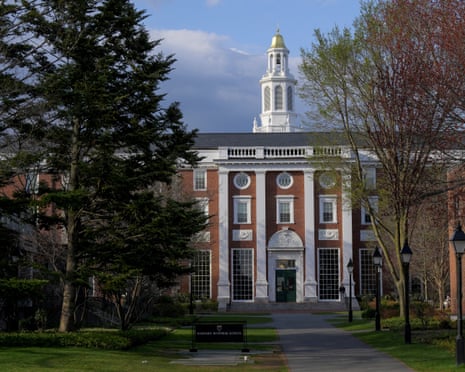
A federal judge has dismissed a lawsuit by the Trump administration that alleged Harvard University failed to protect Jewish and Israeli students from harassment.
In his ruling today, US district judge Richard Stearns in Boston said the Trump administration’s lawsuit, filed in March, had not plausibly shown an ongoing violation of federal civil rights law on Harvard’s campus.
Stearns said the government’s allegations focused largely on incidents amid protests over Israel’s war in Gaza during the 2023/24 school year, with only a handful of later incidents alleged in March 2025 that were “too isolated and episodic” to support a claim of ongoing civil rights violations.
The judge said the lawsuit did not adequately allege failures by the university after the government told Harvard in June 2025 that it was not complying with Title VI of the Civil Rights Act of 1964. It bans discrimination based on race, color and national origin in programs that receive federal funding.
The White House and Harvard did not immediately respond to Reuters requests for comment.
Linked to Hegseth’s recent comments about the conditions on board the USS Abraham Lincoln, the Wall Street Journal is reporting that the USS George Washington will be sent to replace the USS Abraham Lincoln, as part of a previously scheduled rotation plan. The outlet cites unnamed officials familiar with the matter.
Pete Hegseth downplays conditions on USS Abraham Lincoln after reports of food shortages and a mental health crises on board
Defense secretary Pete Hegseth has said that concerns about conditions on board the USS Abraham Lincoln are “completely misrepresented”.
This comes after several reports about food shortages and an intensifying mental health crisis on the vessel, that has now been deployed for more than 200 days, after it was redirected to the Middle East to assist with the military operation in Iran.
“We make sure every ship, every crew, every captain has everything we can provide them at every single moment,” Hegseth told reporters in Panama, where he was attending a military demonstration. “Some deployments are longer than others, and I have more respect and gratitude for those sailors than anybody. What they do in those high seas in those austere conditions with less port calls – it’s incredible.”
Two leading specialist military papers, the Navy Times and Stars and Stripes, are reporting that there have been multiple attempts by sailors to jump overboard as poor conditions and mental stresses on the Lincoln reach the breaking point.
On Wednesday, Democrats on the Senate armed services committee wrote to Hegseth and the acting secretary of the US Navy, Hung Cao, for more information abut what action is being taken to improve conditions on board.
“There have been widespread reports of shortages of basic supplies, water contamination, plumbing issues, deteriorating mental health, deck safety concerns, and disruptions in the mail system, which have caused many care packages in route to the ship to be lost in transit for months,” Richard Blumenthal, a Democrat, wrote. The senator noted that the USS Abraham Lincoln has not made a port call in over 200 days – setting a record for consecutive days at sea.

Melody Schreiber
Donald Trump’s executive order on vaccines does not change the US recommendations for the shots – but experts say it does create confusion and doubt about vaccines, which will lead to more illness and possibly deaths among children and will make it harder for families and pediatricians to protect them.
The executive order was an attempt to reinstate sweeping changes to the vaccine schedule made earlier this year by Robert F Kennedy Jr, secretary of the US Department of Health and Human Services and a longtime vaccine opponent – changes that were later halted by a federal judge.
But an executive order can only offer guidance to agencies; it doesn’t change laws or set recommendations. Recommendations from the US Centers for Disease Control and Prevention (CDC), the federal agency that sets vaccine guidance, remain the same.
“Nothing’s changed,” said Noele Nelson, a public health professor at Cornell University and former pediatrician. The primary effect of the order has been “adding unnecessary confusion” and “undermining trust in vaccines without any change in the scientific evidence”, she said.
While the science and the recommendations are unchanged, “what is going to change is more people are going to be confused and scared”, said Vincent Iannelli, a pediatrician near Dallas and founder of Vaxopedia, a resource on vaccines.
Troy Jackson, the Democratic nominee for the US Senate seat in Maine, has launched a new campaign ad focused on affordability – one of the key issues driving voters to the polls this midterm election.
Jackson replaced Graham Platner on the ballot after the former nominee faced sexual assault allegations, that he denies. However, he now faces an uphill battle to try to unseat five-term Republican senator Susan Collins.
In the ad, Jackson touts his Maine roots as a fifth-generation logger from Allagash– in the northernmost part of the state. “I grew up as a poor kid, in a town full of poor people doing everything right, but struggling to get ahead,” he says in the new spot. “Susan Collins keeps telling us that everything’s fine, but we know it’s not. We all have eyes, paychecks, and bills. We know we’re getting screwed. You deserve better.”
However, Jackson’s ground game is in need of a financial boost to compete with Collins’ war chest of more than $11m cash on hand, according to her latest disclosures. As of now, Jackson’s campaign reports he has amassed $2m since he won the nomination. That’s on top of the $1m he raised since he formally entered the Senate race in early July.
On Wednesday we reported the news that the Trump administration has finalized a rule to end Medicaid reimbursement for gender-affirming care.
My colleague Melody Schreiber has more on how this stands to impact trans youth.
“This is an incredibly dangerous rule,” said Ma’ayan Anafi, senior counsel for health equity and justice at the National Women’s Law Center (NWLC). While advocates have prepared for the policy since it was proposed late last year, it is still “incredibly distressing for our community”, they added.
The US Department of Health and Human Services (HHS) pointed in a press release to international reviews of the medical evidence such as the Cass Review in the United Kingdom, which has been widely criticized for skewing the evidence, but it did not include the more recent landmark report from the Netherlands finding that gender-affirming care is safe and effective, and should be widely supported.
The new HHS policy is “not about following the science. It’s about promoting this administration’s anti-transgender agenda,” Anafi said. “This stigma is really the primary function of this rule.”
It could also add fuel to the rhetoric increasingly being used in state-level bans and restrictions on care.
Legal challenges to the new rule could delay or block the policy entirely, Anafi said: “A lot of courts have recognized that these actions are based on prejudice and they’re not based on evidence – they’re actually contrary to the evidence.”
If it does take effect, there are other options for providing the care. States could use their portion of Medicaid funds, not reimbursed by the US government, to cover gender-affirming care, and individuals and organizations may also ramp up mutual aid efforts.
“Whenever we see restrictions on care that are based on politics and ideology, we know that patients are ultimately suffering,” Anafi said.
Read the full report here:
The Department of Homeland Security (DHS) spent $464m on 10 used airplanes, but has seldom flown the jets, according to a report by the New York Times.
Citing internal documents and people with knowledge of the no-bid contract, the Times reports that the DHS said it had no time to consider other offers for the plans, and they were needed “urgently” for deportation flights.
In their reporting, the Times notes that three of the aircraft are luxury business jets, which were loaned to two other agencies – including the FBI. While seven other Boeing 737s have been parked in Louisiana, because the department did not have the necessary staff available to operate the planes.
The company that received this contract for the used jets, Daedalus Aviation Corporation, has ties to the Trump administration. Its chairman has donated to a Pac supporting the former homeland security secretary Krisit Noem.
Michael Sainato
The Trump administration has been accused of “bullying and intimidation” after a labor union leader and critic was put under investigation and suspended from his job at the Consumer Financial Protection Bureau (CFPB).
Stephen Wheeler, a data scientist at the agency since 2022 and chair of the CFPB union organizing committee, was placed on administrative leave effective immediately earlier this month. The union said it was not provided with any specific violations or given any details of the investigation.
The CFPB – conceived by the Democratic senator Elizabeth Warren to protect consumers after the 2008 financial crisis – has long been a target of Republicans.
When Donald Trumpappointed Russell Vought, architect of the rightwing manifesto Project 2025, to oversee the agency last February, Elon Musk posted, “CFPB RIP,” on X
The labor union representing workers at the agency, the National Treasury Employees Union Chapter 335, noted that Wheeler had been a vocal presence at union pickets, sitting behind Vought during his testimony in Congress in July, and had recently spoken with NPR about the forced relocation of staff at the agency.
Workers have viewed the relocation and return-to-office mandates at the agency as a means to force resignations, after an appeals court blocked attempted mass firings at the agency by the Trump administration in June 2026.
“An investigation with no stated scope or scale is no investigation – it’s a fishing expedition,” Wheeler said. “I have nothing to hide, and when the facts are examined this will be seen for what it is: bullying and intimidation for union activity and protected speech.”
Max Miller’s ex-wife sues him for ‘recklessly’ publishing an image of their daughter as part of custody battle
Emily Moreno, the ex-wife of the embattled congressman Max Miller, has sued her former husband and his lawyer for uploading a picture of their infant daughter to a publicly accessible Dropbox folder as part of their custody battle.
The complaint argues that Miller “recklessly published and disclosed to the world a nude image” of their daughter.
The photos were part of a tranche of evidence that Miller’s team compiled in response to the domestic abuse allegations the lawmaker is facing following his divorce.
The suit says that Miller – who is seeking re-election despite a wave of calls to resign – “so desperately wanted to salvage his political job” that he “recklessly and intentionally” provided his lawyer (Aaron Minc) with “a trove of documents and photos, indifferent about what they contained or how they were used.”
Miller then shared the link to the files online after he went live on social media to refute the allegations against him on 2 August.
Moreno’s lawyers note that “more than 400,000 people saw or interacted with” Miller’s posts containing the Dropbox folder.
The lawsuit – filed in US district court for the Northern district of Ohio – demands the court award $150,000 in damages for “every time someone accessed, transferred, distributed, published, or downloaded the image” of their daughter.
At the time, Minc had accepted sole responsibility for inadvertently releasing the unredacted image of Moreno and Miller’s daughter in the files.
Donald Trump is in Washington today. He’ll spend most of day in private meetings that will be closed to the press. We’ll keep an eye out for any more information on the president’s replacement pick for White House press secretary, following the news that Karoline Leavitt would step down from her role at the end of August.
A federal judge in Miami will hear arguments on Thursday over whether social media influencers Andrew and Tristan Tate should remain in custody as they fight extradition to the United Kingdom, where the brothers are accused of rape and sex trafficking.
Magistrate Lauren Louis will have a chance to question both sides before determining if the brothers, who have repeatedly denied wrongdoing, should stay in jail or be released during what could be a months long extradition process.
The Tate brothers have remained in a federal detention center in Miami since making a brief court appearance two days after their 18 July arrest. Their attorneys have argued the Tates’ high profile makes it nearly impossible for them to flee and that they regularly post updates about their locations on social media.
According to the US attorney’s office filing, the Tates should be detained pending their extradition hearing because they cannot overcome the strong presumption against bail in international extradition cases.
ICE’s plan to give officers electric shock gloves draws outrage and fears of misuse
Immigration and Customs Enforcement’s plan to give officers gloves that deliver painful electric shocks faced criticism Wednesday from Democratic elected officials and civil rights advocates, who called it unnecessary and cruel.
ICE plans to spend between $10m and $20m to outfit officers and agents with “conductive distraction and de-escalation devices,” according to a notice published Monday and revealed first by The Associated Press.
The devices known as the G.L.O.V.E., which stands for Generated Low Output Voltage Emitter, are normal patrol gloves until an officer presses a button to activate its electrical mode.
They must be applied directly to someone’s skin to produce a voltage that causes pain, which is intended to gain compliance from people who are resisting. Unlike Tasers, they do not leave burn or contact marks.
The size of the purchase suggests ICE plans to give the device to most or all of its officers. The gloves have been used by local departments more often in jails than in the streets, where ICE officers have increasingly used force to extract people from cars and faced protests over their actions carrying out President Donald Trump’s crackdown on illegal immigration.
The Department of Homeland Security, ICE’s parent agency, says it Is working to ensure officers “have the tools and equipment necessary to safely arrest and remove criminal illegal aliens.”
Karoline Leavitt steps down as White House press secretary three months before midterms
Hello and welcome to the US politics live blog.
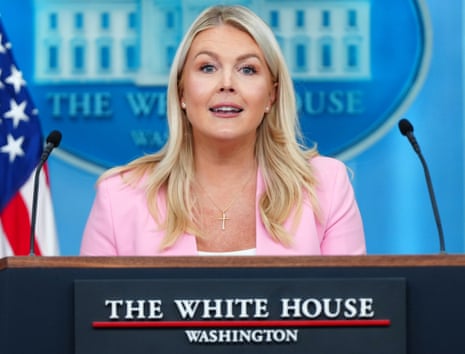
White House press secretary Karoline Leavitt’s decision to step down from the role comes less than three months before the midterm elections.
President Donald Trump announced yesterday that Leavitt will leave her role at the end of the month to spend more time with her young family.
Leavitt, 28 and the youngest person to hold the role, called it a “bittersweet decision” in a social media post Wednesday shortly after President Donald Trump made the announcement.
She is expected to remain involved as an outside Trump adviser and influential Republican voice.
Trump said he supported the move, though some argue it has come at a pivotal time for the president, with midterm elections due to be held on 3 November 2026.
Historically, the president’s party tends to lose seats in midterm elections, and Trump’s low approval ratings could pose a challenge for Republicans in November.
Donald Trump’s net approval rating has fallen to -27, a new record low, according to The Economist’s tracker of YouGov polling.
Her departure has also raised questions over who will replace her as White House press secretary and take on the crucial task of communicating the administration’s message in the run-up to the midterm elections.
The administration has not yet announced who will replace Leavitt.
In other developments:
-
The two most senior members of President Donald Trump’s Cabinet, secretary of state Marco Rubio and Treasury Secretary Scott Bessent, flew out of last month’s Nato summit in Turkey on what was effectively a decoy plane after an Iranian threat, while Trump was secretly moved to a smaller military jet, a senior US official said Wednesday.