on
Why Lowering Temps Weaken The Gas Struts Holding Up Your Hood, Hatch And Trunk Lid - Jalopnik
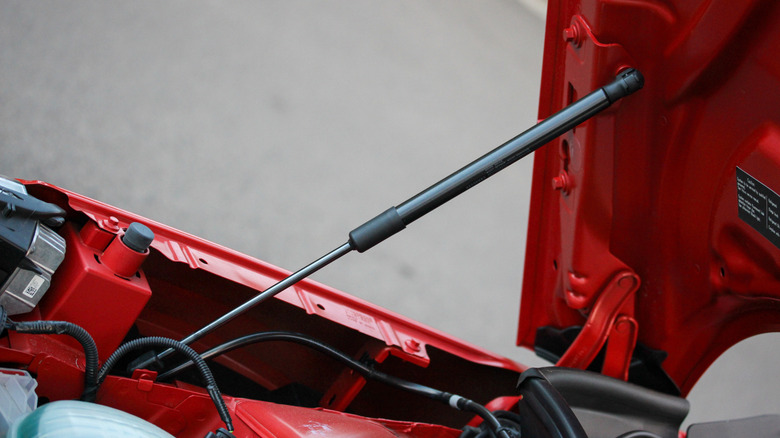
Hanjo Stier/Shutterstock
Winter is hard on cars. Motor oil gets thick, tire pressures drop, road salt eats away at subframes, EV range drops like a stone, and the act of driving itself can become a real nightmare. But there's another part of your car that cold weather wreaks havoc on that you may never have thought of: the gas struts that hold up your car's hood, hatchback hatch, or trunk lid... or, if you've got money like that, maybe even its Lamborghini-style scissor doors.
Gas struts are those black cylindrical things on either side of those openings that allow them to stay open without you holding them open manually or fiddling with a hood prop. Often known to make a small, reverse-hissing noise as the thing it supports opens, these rely on gas, which — as anyone who paid attention in science class should recall — is affected by extreme temperatures.
Specifically, gas pressure changes roughly 3.5% for every temperature swing of 18 degrees Fahrenheit. For the physics nerds, this is derived from Gay-Lussac's gas law, which says increasing the temperature of a gas, given constant volume, increases its pressure as well. And per kinetic-molecular theory, the kinetic energy of molecules is directly proportional to temperature. The opposite is also true: Gas pressure decreases in the cold since the tiny moving particles that make up gas slow down as temperatures go down.
My trunk lid's fallen and it can't get up

Oksanaradchenko/Getty Images
Since the gas springs in your car are filled at around 68 degrees Fahrenheit, large enough deviations from room temperature can cause notable changes to how well your car's gas springs work. Given cold snaps in, say, the Northeastern U.S. where temps can dip below zero, gas spring pressure can change 10 to 15%. The inherent pressure change itself can cause your hood, hatch, or trunk lid to slowly drop or not stay up at all, but it can also cause that gas to leak. And, of course, cheaper or less well-made gas springs are more prone to this than nicer ones that may incorporate mechanical locks to curb this very phenomenon.
Inversely, extreme heat could cause the spring to be too stiff, making it hard to close whatever it's supporting. These springs also use oil that helps make the operation smoother, and naturally, extremely high temps can thin the viscosity of the oil in the springs, and, in turn, change how that hood or whatever feels to open and close. Still, unless you're regularly sticking your head and hands under a hood that could fall down in freezing temperatures, though, failing gas struts are admittedly one of the more tame consequences of winter motoring. But if you ever find yourself closing your hatch in the dead of January and feeling like it's a little light — or that it's pushing back more than before in the summer heat – you know what's happening.