Face-to-face with ancient Rome: Exhibition in Hungary brings forgotten faces to life

A blacksmith, a stable boy, a soldier, a slave: The faces and stories of these and other residents of an ancient Roman city in modern Hungary have been brought to life in remarkable fidelity for a new exhibition in Budapest.
Climate change is forcing amphibians to change their diet—but they can only adapt so far

New research involving Queen Mary University of London reveals that amphibians can change what they eat to cope with rising temperatures, but that this natural survival strategy has limits.
Lakes that 'breathe' ancient carbon: A surprising find in the Congo Basin

In the heart of the Congo Basin's Cuvette Centrale, a large depression that hosts the world's largest tropical wetland complex, lie two vast, shallow blackwater lakes, Lake Tumba and Lake Mai Ndombe. Together, they are roughly the size of 420,000 football fields.
Human noise pushes Alaska predators toward night foraging, altering salmon nutrient pathways

The age-old question asks, "If a tree falls in a forest and no one is around to hear it, does it make a sound?" While philosophers and scientists alike have pondered this question for centuries, the more relevant question for today's recreation and wildlife managers is: Does it matter what makes the sound?
Well-designed urban street plantings provide relief from summer heat

New research shows that improvements in tree, shrub and grass plantings along city streets in Queensland can substantially improve pedestrians' thermal comfort.
Disturbance has a greater effect on giant kelp productivity than resource availability
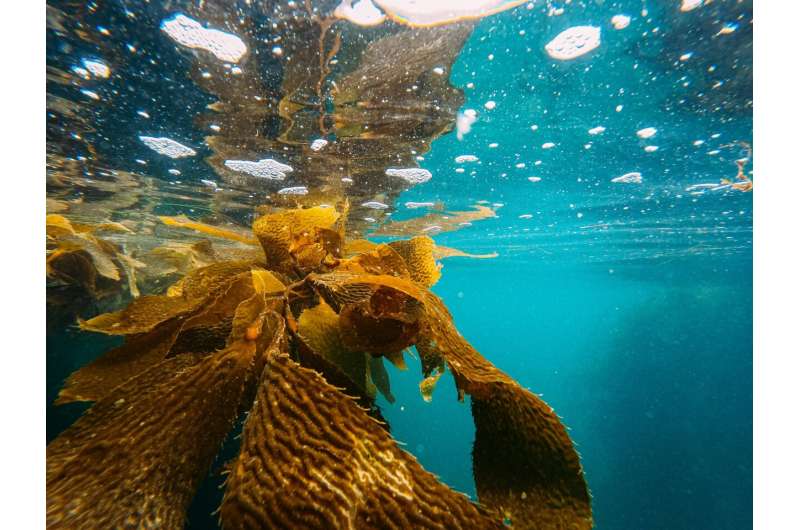
Marine scientists at UC Santa Barbara have found that disturbances to giant kelp forests have a major influence on their net primary productivity (NPP)—an indicator of an ecosystem's health and its ability to support its community—even more so than the availability of the resources needed for growth. Using data from decades of monthly measurements in the kelp forests at the campus's National Science Foundation-supported Santa Barbara Coastal Long Term Ecological Research (SBC LTER) site, the researchers uncovered the direct, indirect and fascinating effects of disturbance on one of the world's most productive ecosystems.
Study reveals Hawaiian hotspot is getting hotter

Contrary to conventional geological thinking, the Hawaiian mantle plume has gotten hotter by about 250°C (480°F) over the past 47 million years. This discovery, led by Earth scientists at the University of Hawai'i at Mānoa, reverses the long-held idea that hotspots start out very hot and progressively cool over time. The study, published recently in Earth and Planetary Science Letters, also found that heat surges produced the two largest volcanoes along the Northwestern and Main Hawaiian Island chain.
Underwater microphones detect dolphins in Sea of Japan bays about once every ten days

When residents of two coastal communities along the Sea of Japan reported observing dolphins in nearby waters, it caught the attention of some scientists. The marine environment has been changing rapidly in the Sea of Japan, which is partially enclosed by the Japanese archipelago and the Eurasian continent and connected to the ocean through shallow straits. Though dolphin sightings and bycatch records have been reported along the coast, basic ecological information on small odontocetes, such as dolphins and porpoises, has remained limited.
A 37-year soil experiment revealed a hidden climate threat
After nearly 40 years of research, scientists have uncovered evidence that challenges a long held assumption about forest soils. The world's longest running soil warming experiment suggests that even carbon once considered stable can begin to break down as temperatures rise, releasing additional CO2 into the atmosphere.
Shear loading reveals sixfold damage growth around stiff particles in aluminum alloy

The resistance of materials to mechanical loads is a decisive factor in component safety, such as in aircraft. Working as part of an international team, researchers from the Karlsruhe Institute of Technology (KIT) have found a previously unknown damage mechanism in metals: Contamination in the form of stiff particles can cause the volume of voids to increase up to sixfold when exposed to deformation by shear loading.